

On April 27, Iranian Foreign Minister Abbas Araghchi landed at St. Petersburg’s Pulkovo Airport on a plane named Minab 168, a reference to the elementary school in the Iranian city of Minab struck on the opening day of the war and the 120 children killed there. Before any meeting had taken place, Tehran had framed the visit in the terms it wanted: a country absorbing catastrophic losses, arriving in Moscow not to ask for charity but to coordinate with a partner it has come to depend on. The purpose of the visit was a two-hour meeting between Araghchi and President Vladimir Putin at the Yeltsin Presidential Library, the first visit by Iranian leadership to Russia since the latest US-Israeli attacks, and one that Moscow itself described as difficult to overstate in importance.
The St. Petersburg meeting was not the only engagement that day. While Araghchi sat with Putin, Iran’s Deputy Minister of Defence for Strategic Planning, Brigadier General Reza Talaei-Nik, held separate meetings with Russian Defence Minister Andrei Belousov and Belarusian Defence Minister Viktor Khrenin. The visits came as the ceasefire mediated by Pakistan, in effect since April 8, remained strained by disputes over the Strait of Hormuz and a US blockade on Iranian ports, with US-Iran talks having collapsed over the preceding weekend.
St. Petersburg Meeting
The meeting between President Vladimir Putin and Foreign Minister Araghchi at the Yeltsin Presidential Library lasted approximately two hours. It was the first visit by Iranian leadership to Russia since the latest US-Israeli attacks. The significance was not lost on Moscow. Kremlin spokesman Dmitry Peskov said beforehand that “it is difficult to overstate the importance of this conversation given how the situation around Iran and the Middle East is developing.”
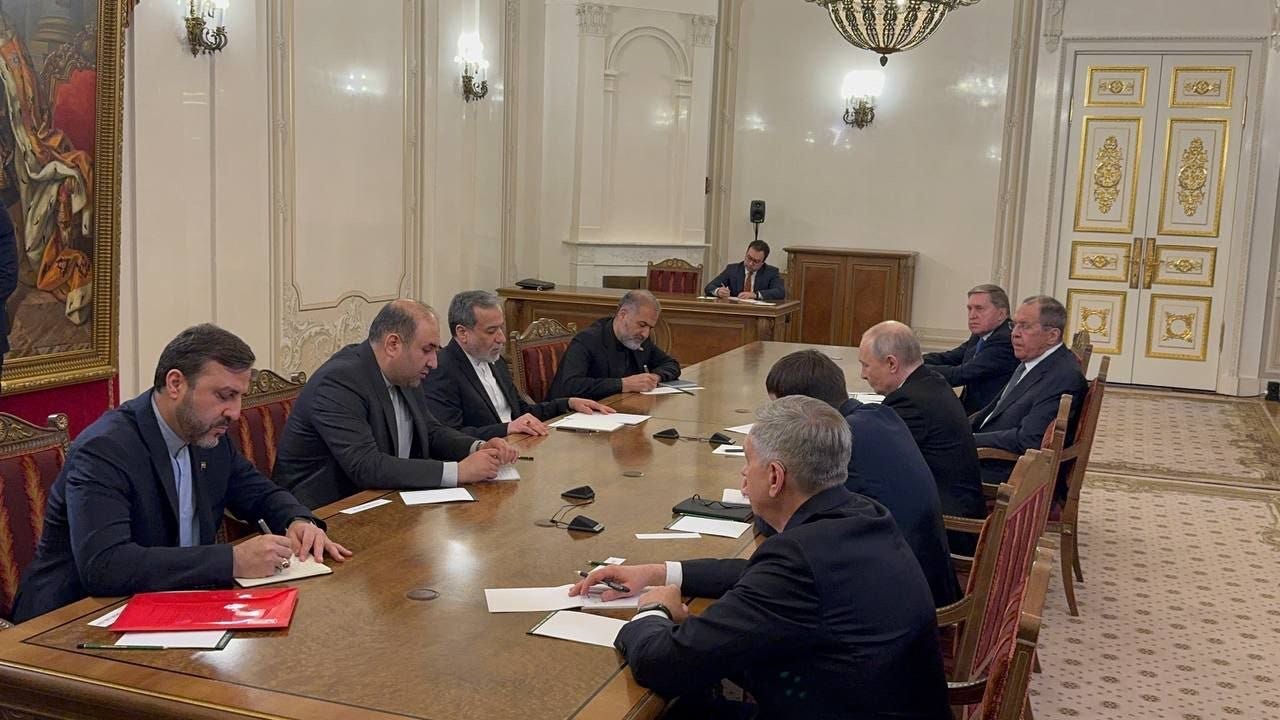
Putin opened by making the personal stakes of the relationship explicit. He told Araghchi that he had received a message from Iran’s Supreme Leader the previous week, and asked him to convey his sincere gratitude, confirming that “Russia, just like Iran, intends to maintain our strategic relations.” He then offered an unambiguous declaration of solidarity:
“We see how courageously and heroically the Iranian people are fighting for their independence and sovereignty. And, of course, we very much hope that, relying on this courage and determination for independence, the Iranian people, under the leadership of their new leader, will go through this difficult period of trials and that peace will come. For our part, we will do everything that meets your interests and the interests of all peoples in the region in order to ensure that this peace is achieved as quickly as possible. You are well aware of our position.” Vladimir Putin, Kremlin Readout
Araghchi responded in kind. He confirmed he had been specifically tasked with delivering a message: that Iran regards Russia as “a strategic partnership at the highest level,” and that regardless of everything that is happening, Iran-Russia relations will continue to grow stronger. He told Putin that recent events had “proven to the whole world” that Iran has “friends and allies such as the Russian Federation, who stand by Iran in difficult times.”
“I have been asked, during this visit, to confirm that Iran-Russia relations are regarded by us as a strategic partnership at the highest level, and that we will continue along this path. Regardless of everything that is happening, Iran-Russia relations will continue to grow stronger. As you rightly noted, it has been proven to the whole world that the Iranian people, through their resistance and courage, were able to withstand American attacks and aggression, and will endure and stand firm during this period. It has also been proven to everyone that Iran has friends and allies such as the Russian Federation, who stand by Iran in difficult times. We are grateful to you for your firm and strong positions in support of the Islamic Republic of Iran.” Abbas Araghchi, Kremlin Readout
On the Russian side, the delegation’s composition told its own story. Joining Putin were Foreign Minister Sergey Lavrov, Presidential Aide Yuri Ushakov and Igor Kostyukov, the head of the GRU’s Main Directorate of Military Intelligence. It is not the first time Kostyukov has appeared at a Russia-Iran meeting. In June 2025, when Araghchi visited Moscow near the end of the 12 Day War, Kostyukov was present then too.
What can be gleaned from the public portion of the St. Petersburg meeting — the opening statements, the pool footage, and the read-outs released by both sides — points to a conversation that unsurprisingly was tied to the ongoing war.
On the diplomatic side, Russia has been a meaningful asset for Iran throughout the conflict, and the St. Petersburg meeting was in part an exercise in coordinating positions as much as exchanging information. Araghchi briefed Putin on the Pakistan-mediated diplomatic process aimed at ending what Tehran calls the “imposed war” and establishing security in the Persian Gulf, including the Strait of Hormuz, while blaming slow progress on Washington’s “destructive habits.” Russian diplomatic support has been crucial for Iran throughout the war and Iran reasonably sought to coordinate with its most vocal supporter.
On the nuclear file, Russia has repeatedly proposed removing and storing Iran’s stockpile of highly enriched uranium, with Rosatom head Alexei Likhachev describing Russia as the only country with positive experience cooperating with Iran” and confirming readiness to facilitate the transfer. But Iran has shown no appetite for this arrangement. Tehran regards its enriched uranium stockpile as its primary remaining source of strategic leverage in negotiations (for now). The significance of the Russian offer therefore lies less in its immediate prospects and more in what it signals about the direction of travel if Iran’s calculus changes. Should Tehran ever conclude that exporting its enriched uranium is necessary as part of a negotiated settlement, the architecture of that transfer would almost certainly run through Moscow. Russia is the only actor with the technical infrastructure, the existing bilateral nuclear relationship, and the political positioning to serve as custodian. Kremlin spokesman Peskov has acknowledged the proposal is currently “not on the negotiating table,” with Washington showing no interest. But the offer remains open, and its continued existence on the table preserves Russian centrality to any eventual nuclear resolution, whether or not Iran chooses to move in that direction.
What the public record cannot tell us is considerable. The two-hour duration of the meeting, the closed-door structure, and the presence of GRU chief Igor Kostyukov in the Russian delegation all suggest the conversation went considerably further than the released statements indicate. Whether those discussions encompassed expanded intelligence sharing arrangements, direct transfers of military systems, or the formalization of cooperation frameworks that have until now operated informally cannot be established from open sources.
Bishkek Meetings
While Araghchi was in St. Petersburg, a parallel meeting was unfolding 3,500 kilometres away. Russia’s Defence Minister Andrei Belousov met in Bishkek with Iran’s Deputy Minister of Defence for Strategic Planning, Brigadier General Reza Talaei-Nik on the sidelines of the Shanghai Cooperation Organization Defence Ministers’ summit.
Like Putin, Belousov also issued a clear statement of support for Iran: “We stand for resolving the conflict exclusively through diplomatic means. We support the sovereignty and territorial integrity of Iran. I wish the brotherly Iranian people and its armed forces steadfastness and courage in overcoming all the threats facing the country.”
There was no reciprocal Iranian readout from Bishkek, only a few state media reports. Those following Iran, specifically Russia-Iran, would know that it’s a bit strange for the Iranian side to refrain from issuing multiple statements with such a visit. It could be a matter of prioritization within their public affairs office. According to Mehr, Talaei-Nik did meet with his Pakistani counterparts as well.
Talaei-Nik also met with Belarusian Defence Minister Viktor Khrenin. Both officials agreed that the sole path to resolving the conflict was “a return to the sphere of a political-diplomatic settlement and the intensification of the process of negotiations.” The Belarusian ministry statement said the meeting “confirmed the mutual interest of Minsk and Tehran for a further deepening of their joint interaction.”
The SCO Defence Ministers’ summit in Bishkek was a scheduled, routine multilateral event. Iran’s participation was not in itself significant. What merits attention is the level at which Tehran chose to engage and who it sent. Talaei-Nik is part of the IRGC establishment, a close associate of Mohsen Rezaei — the former IRGC commander-in-chief and longstanding proponent of deepening ties with Moscow. His attendance at a wartime bilateral with Russia’s defence minister is therefore not incidental to his political lineage. That Iran sent its Deputy Defense Minister likely reflects the constraints of the wartime situation at home, where the Defence Minister has other priorities.
The meeting with Belarus Defence Minister Viktor Khrenin, which Talaei-Nik conducted on the same trip, fits an established and accelerating bilateral pattern. In March 2025, Iran’s then-Defence Minister Nasirzadeh and Khrenin signed a defence cooperation agreement in Minsk, described by the Iranian side as “an effective step towards strengthening defence and security interactions.” That followed the signing of a comprehensive cooperation roadmap for 2023-2026 and, by August 2025, the two countries had elevated the relationship further: Presidents Pezeshkian and Lukashenko signed a package of 13 cooperation documents in Minsk, with Araghchi announcing plans to revise the bilateral framework toward a full strategic partnership.
Reconstruction
Underlying all of these meetings is a challenge that will outlast any ceasefire agreement. Iran’s central bank has warned President Pezeshkian that rebuilding the country’s war-damaged economy could take more than a decade, with senior economic officials assessing that the damage inflicted during the 40-day war — combined with Iran’s already fragile economic situation — could take up to 12 years to repair. Major airports were damaged during the conflict, while strikes also targeted oil facilities, refineries and petrochemical installations central to Iran’s export revenues.
The reconstruction challenge Iran faces is not only about rebuilding physical infrastructure. It is about reconstituting a degraded military-technical base under conditions of continued sanctions, active Western interdiction, and an ongoing intelligence deficit that the war has made acute. On all three dimensions, Russia and Belarus have things to offer though the picture is more complicated than the political optics of April 27 suggest.
On the intelligence side, the breadth of Russian support during the war has been better documented than Moscow would prefer. Russian satellites conducted dozens of detailed imagery surveys of military facilities and critical sites across the Middle East to help Iran strike US forces and other targets. The intelligence cooperation between Iran and Russia has proven to be useful for Moscow too as Iran has provided its own data on the performance of its systems. It is also a realm that will likely persist in the coming years.
On hardware and components, the record prior to the current war already established a pattern of Russian transfer that the conflict has now dramatically accelerated. Russia has been capturing US and NATO-provided weapons and equipment from the battlefield in Ukraine and sending them to Iran, where Washington believes Tehran attempts to reverse-engineer the systems. That pipeline, established years ago, now operates in a context where Iran’s own military-industrial base has taken severe damage and its appetite for foreign technical input has sharply increased. Belarus’s utility here deserves more attention than it typically receives. Its defence industrial base has been rapidly expanded in the context of its integration into Russia’s war economy, and that infrastructure now has potential application to Iran.
Whether Iran integrates itself more deeply into Russian, Belarusian, and Chinese military supply chains, or finds sufficient economic relief to rebuild its military-industrial complex independently, will be among the most consequential questions shaping the Iranian military in the years ahead. These meetings will likely be viewed in the immediate context of the war but also are part of the process by which Iran is mapping its options and securing its relationships for its daunting challenge of postwar reconstruction.

