

As the war enters its second month, it is increasingly clear that this is not a single campaign unfolding across one continuous battlespace, but several overlapping campaigns operating across different theaters. The Gulf is one of them, but it is not the whole war. Alongside the strikes on Gulf states, Iran has also been running a campaign against Israel and a parallel maritime campaign aimed at shipping, ports, and the wider commercial infrastructure of regional trade. These theaters are connected, but they are not identical in their target sets, operational logic, or coercive purpose.
The Gulf campaign, in particular, is best understood as a distinct theater within the larger war. Once examined on its own terms, several overlapping but analytically separable lines of effort emerge. They were not cleanly divided, and the pattern almost certainly shifted in response to evolving conditions: the effectiveness of Gulf air and missile defenses, the pace of U.S.-Israeli operations inside Iran, Iranian stock constraints, and other internal dynamics that remain difficult to reconstruct from open sources. Even so, the broader pattern suggests prioritization rather than indiscriminate retaliation. It also suggests that that prioritization changed over time in ways that matter.
At the broadest level, the logic is not hard to see. In the Gulf, Iran was trying to impose costs on the regional architecture that allowed the United States and its partners to generate combat power against Iran from outside Iranian territory. But that architecture is not distributed evenly. Some states matter more for sustainment and rear-area support. Others matter more for air operations, missile defense, naval command, energy exports, or the commercial infrastructure within which coalition operations are embedded. The targeting reflects those differences.
The pattern also shifted over time. The opening phase was broader, noisier, and more geographically expansive, which made sense. In the first days, Iran had incentives to show that it retained regional reach and that multiple Gulf states could be pulled into the battlespace at once. As the campaign continued, the distinctions within the Gulf theater became clearer. In some cases, especially Kuwait and Saudi Arabia, the strikes narrowed more toward military and support infrastructure. In others, especially Qatar and the UAE, Iran kept a broader target menu open for longer. That makes the Gulf campaign look less like a single regional barrage and more like a distinct theater that became more differentiated as the war has gone on.
U.S. military assets
The most consistent line of effort across the four weeks was directed at the U.S. military architecture in the Gulf. That campaign was distributed across multiple states, but it was not evenly distributed. Kuwait stood out as the clearest case where Iran appears to have concentrated on American military infrastructure and the support architecture around it.
The two most important nodes there were Ali Al Salem Air Base and Camp Arifjan. Ali Al Salem matters because it is a long-standing forward operating location for U.S. airpower in Kuwait and supports air operations across the northern Gulf and into Iraq. Camp Arifjan matters for a different reason. It is not simply another U.S. facility; it is a logistics and command hub that helps sustain the ground and support architecture behind American operations in theater. Together the two sites represent different layers of U.S. military presence: one tied more directly to airpower, the other to operational sustainment and theater command.
The repeated attention to Camp Arifjan’s radomes is especially notable. Radomes protect communications infrastructure, and the persistence of attacks against them suggests that Iran assigned some priority to satellite communications and related command-and-control nodes. Whether that reflected imperfect battle damage assessment, a desire to prevent repairs, or simply a standing priority on communications targets is difficult to say with confidence. But the pattern is significant. It points to an effort to impose friction on the infrastructure that allows dispersed U.S. forces to operate as a coordinated network.
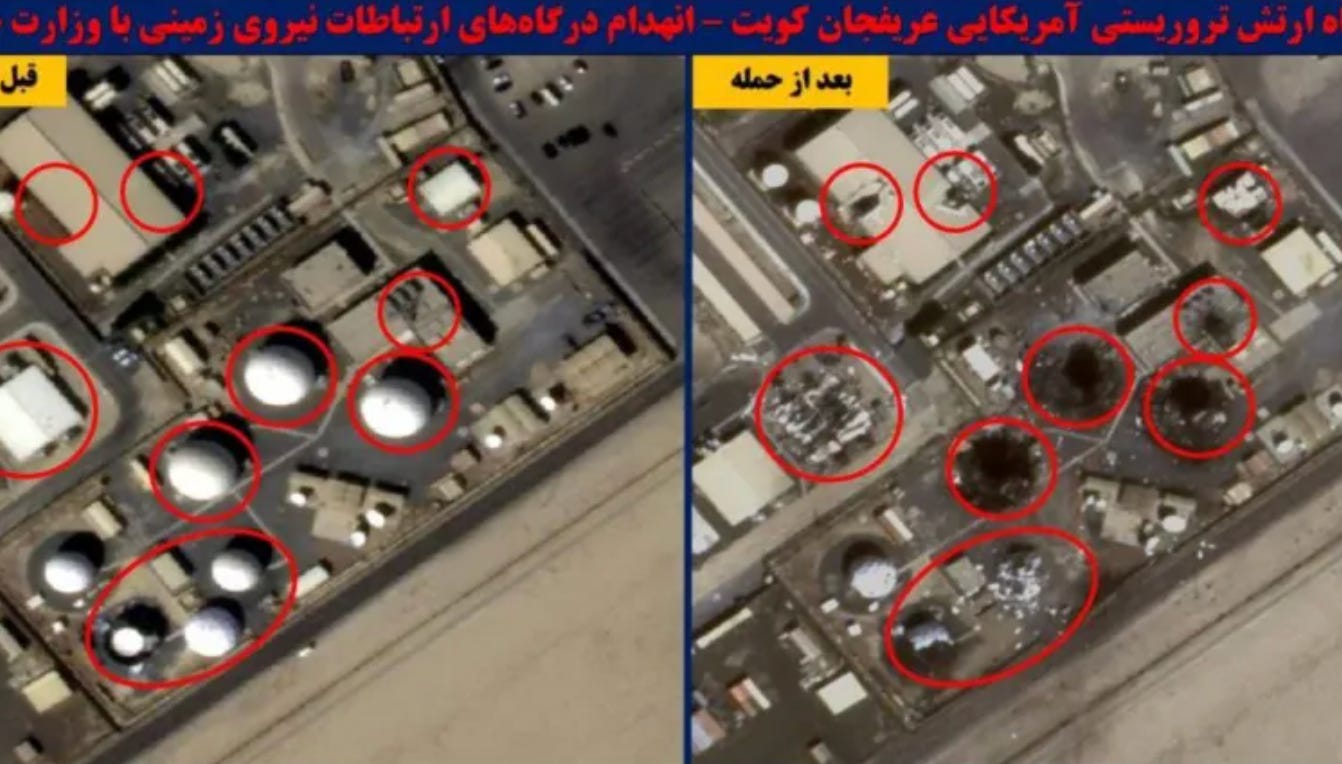
Kuwait International Airport also appears repeatedly. That can be read in two ways, which are not mutually exclusive. It may reflect a dual-use targeting logic, given the airport’s logistical relevance to U.S. operations, or it may indicate that Iran was willing to accept civilian disruption as part of the coercive effect of targeting military support infrastructure in and around Kuwait City. Either way, Kuwait looks less like a theater of broad economic punishment than a theater where Iran focused on the support systems behind U.S. military operations.
Qatar belongs in this same military line of effort, but it occupies a somewhat different place within it. Al Udeid Air Base is one of the principal hubs for U.S. air operations in the region and a key node for command, coordination, refueling, and the wider air campaign architecture. That made Qatar central in a way that differs from Kuwait’s logistical function or Bahrain’s naval one. Iranian pressure on Qatar, therefore carried a different weight. It was aimed less at rear-area sustainment than at one of the core operational platforms through which air operations against Iran were being organized and supported.
The targets in Qatar also reached radar-related sites, air defense activity around Doha, Doha International Airport, industrial infrastructure, and LNG-linked nodes such as Ras Laffan and Mesaieed. That broadens the picture. Qatar looks less like Kuwait, where the emphasis was more tightly concentrated on support architecture, and more like an intermediate case between a military theater and an industrial pressure theater. Al Udeid remained the centerpiece, but the inclusion of LNG and industrial targets suggests that Iran was willing to hold at risk not only the base complex itself but also some of the economic infrastructure that gives Qatar broader strategic significance.
Bahrain fits into this emphasis on U.S. assets as well, though again in a different way. Bahrain hosts the Fifth Fleet headquarters at Naval Support Activity Bahrain and is one of the most concentrated nodes of U.S. naval command infrastructure in the region. In theory, the density and strategic importance of that target set should have made it a high-priority theater. In practice, the campaign there was more limited than that logic alone would suggest. The most plausible explanation is that Bahrain’s small geography and the concentration of high-value targets alongside dense defensive coverage made it a harder environment in which to achieve meaningful penetration. Put differently, Bahrain appears to have remained a target of real strategic interest, but not a permissive one.
Saudi Arabia presents a more complicated version of the same military logic. Prince Sultan Air Base is one of the most important U.S.-linked airpower nodes in the region, and on paper it should have made Saudi Arabia a major theater from the start. Yet the early phase of the campaign was relatively restrained compared with Kuwait. That may reflect political calibration. Iran may have wanted to avoid early escalation with a state whose role in global energy markets imposed different strategic constraints than those associated with Kuwait or Bahrain. Distance, defenses, and target access may also have mattered. Whatever the reason, Saudi Arabia was initially underweighted relative to the significance of the military assets on its territory.
The economic coercion campaign
If Kuwait was the clearest case of anti-American military targeting, the UAE looks like the center of gravity of something related but distinct: a sustained effort to impose economic costs and generate psychological pressure on a Gulf host state by targeting commercial and civilian infrastructure alongside military-adjacent systems.
What stands out in the Emirati case is not only the volume of activity, but the type of sites that recur. The UAE was treated not simply as a military host state, but as an economically and psychologically vulnerable one. For instance, Dubai International Airport appears repeatedly. So do Abu Dhabi’s urban coastline, the Fujairah Oil Industry Zone, and dense residential and commercial areas tied to the UAE’s expatriate-heavy economy. The target environment in the UAE was not built around one or two major American military nodes. It was broader, and more closely connected to the civilian-commercial systems on which the Emirati economy depends.
Dubai International Airport is the clearest example. It is central to Dubai’s status as a global logistics, financial, and services hub. A campaign against it does not need to shut the airport down permanently to impose costs. It only needs to make operations riskier and less predictable—to raise insurance premiums, disrupt airline planning, unsettle logistics chains, and reinforce the sense that Gulf connectivity cannot be taken for granted under wartime conditions. The same logic applies, in a somewhat different way, to Fujairah. Its significance lies in its role outside the Strait of Hormuz, as an energy storage and loading hub that helps Gulf exporters reduce chokepoint vulnerability.
Qatar partly overlaps with this second line of effort, though in a narrower way. The difference is that in Qatar the economic pressure component appears to have been built around industrial and energy infrastructure rather than around the broader urban-commercial environment. Ras Laffan and Mesaieed matter not because they resemble Dubai, but because they sit at the core of Qatar’s LNG and industrial economy. Qatar therefore does not belong in the same category as the UAE, but it does show that Iranian planners were not rigidly separating military and economic targeting. There were echoes of this logic elsewhere. Bahrain’s port and financial districts, and Kuwait International Airport, show that economic and civilian-adjacent targeting was not unique to the UAE. But nowhere else was it so sustained or so central to the campaign’s overall character.
The late Saudi shift
The most important change over the course of the campaign was not visible on the opening day. It emerged later, when Saudi Arabia became a more active theater and the character of Iranian targeting there changed.
In the early and middle phases, Saudi Arabia absorbed comparatively limited activity relative to the significance of Prince Sultan Air Base and other military infrastructure on its territory. In the final stretch, that changed. Strike activity increased, and more importantly, the target set broadened. Prince Sultan and Riyadh remained relevant, but late in the campaign Iranian attention expanded to include Saudi energy export infrastructure, especially Ras Tannura, Yanbu, and maritime-industrial zones near Al Jubayl.
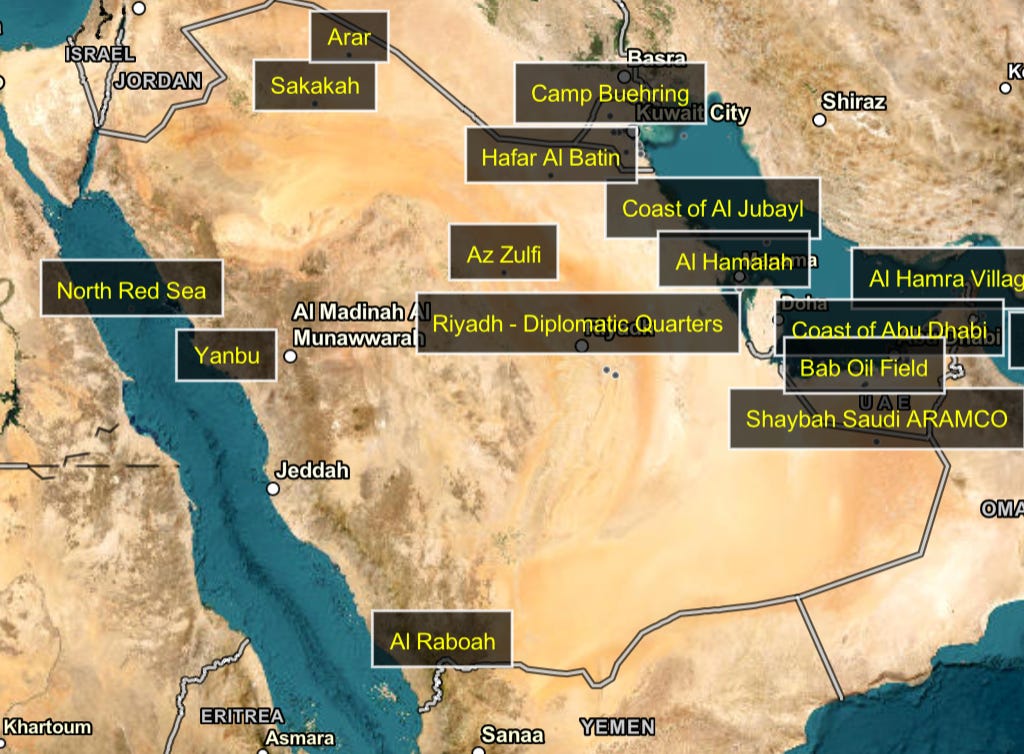
That shift matters because it was not simply a matter of more strikes on Saudi territory. It represented a move toward targets with potentially global economic consequences. Ras Tannura is not just another oil facility. It is the most important crude export terminal in the world. Yanbu extends the same vulnerability into the Red Sea corridor. A campaign that threatens both Gulf and Red Sea export routes is qualitatively different from one centered only on military bases or local industrial nodes. It suggests awareness not only of Saudi Arabia’s military role, but of its strategic position in global energy markets.
Why this shift occurred when it did is harder to determine. One possibility is that it reflected strategic recalibration after the more visible coercive effects sought in the UAE proved harder to convert into operationally meaningful damage. Another is that the campaign did not slow so much as move: away from a theater where defenses were absorbing a large share of the incoming pressure and toward one where successful penetrations, if achieved, might carry greater global consequences. Either way, the late Saudi phase stands out because it indicates that Iran’s campaign did not remain fixed on its opening priorities. It evolved.
What the campaign reveals
Taken as a whole, Iran has pursuing at least two overlapping lines of effort from the beginning: an anti-American military campaign centered most clearly on Kuwait and, to a lesser degree, Bahrain and Qatar, and an economic coercion campaign centered on the UAE. Later, it expanded pressure on Saudi Arabia.
Interception rates appear to have been high, especially in the opening phase. Some of the most consequential targets seem to have been engaged without producing the kind of sustained operational degradation that would fully validate the logic behind them.
Even without a full comprehension of the level of damage, the targeting logic itself is already visible. Iran appears to have placed greater emphasis than in previous conflicts on the infrastructure that enables military power: communications nodes, support systems, export terminals, transport hubs, industrial facilities, and commercial sites whose continued function depends on perceptions of stability.
If that reflects a real doctrinal evolution rather than wartime improvisation, it matters beyond this campaign. Future Iranian operations in a conflict of this scale may look similar. That has implications not only for base defense, but for how the United States and Gulf states think about force posture, redundancy, and the vulnerability of military operations in the region.