

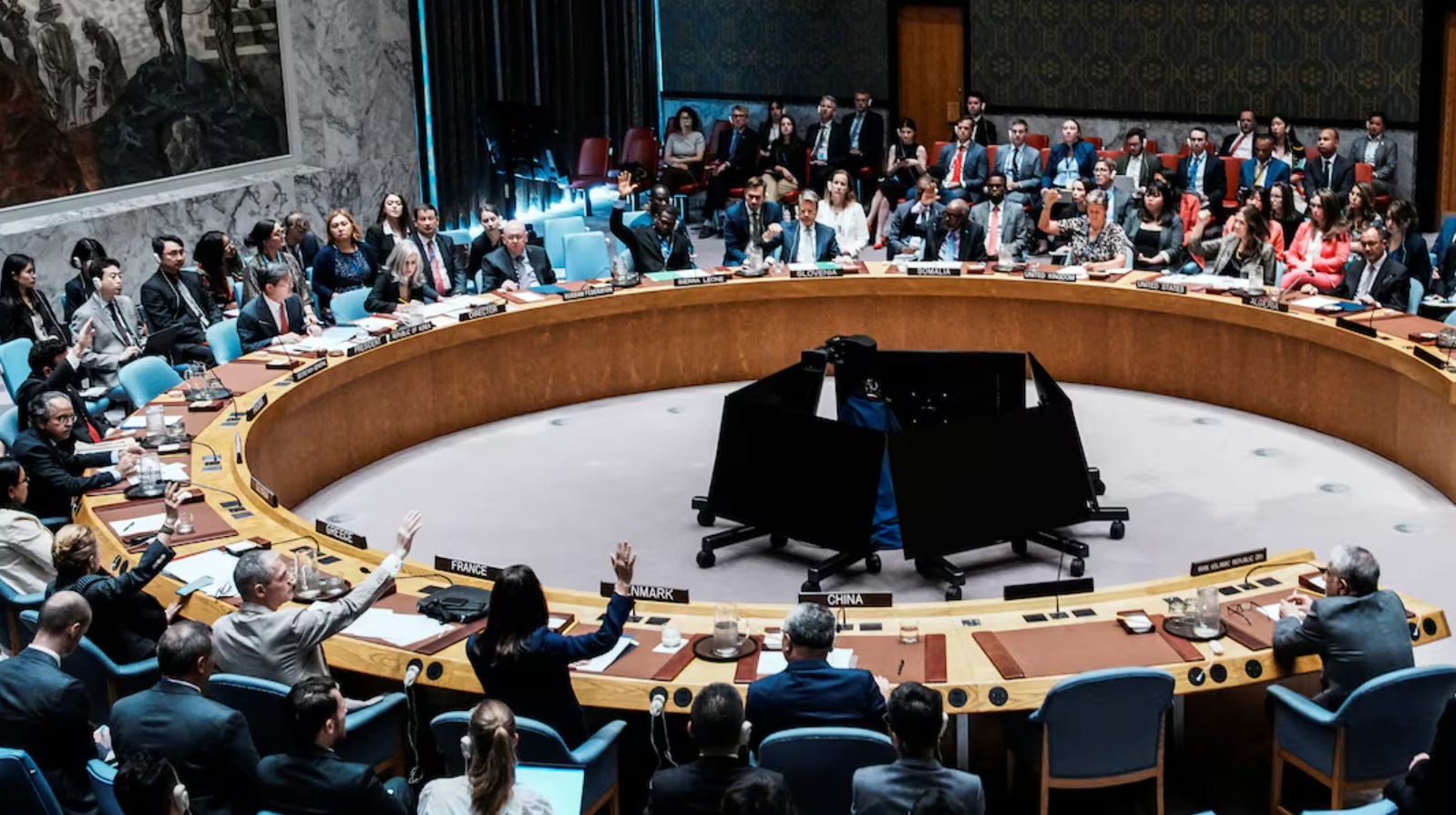
On September 19, the United Nations Security Council voted on a resolution that could have blocked the automatic reimposition of UN sanctions on Iran. The motion failed. Of the 15 members, only Russia, China, Algeria, and Pakistan voted in favor. Nine members—including the U.S., UK, and France—voted against it, and two abstained. With the resolution failing to reach the threshold for adoption, the path is now clear: unless a diplomatic miracle intervenes, all previous UN sanctions on Iran will be reinstated by September 28 through the “snapback” mechanism of Resolution 2231.
Russia has made clear that it will neither recognize nor comply with the reimposed sanctions. For months, Moscow has tried to delay, discredit, and diplomatically block the E3’s push toward snapback. And Moscow has made one thing abundantly clear: if the snapback goes through, Russia will not recognize it and will not comply.
This post kicks off a new series of commentary on Russia and the Iran nuclear issue. The first installment examines the controversy over snapback and the legal arguments Moscow has advanced to challenge it. Future posts will turn to Russia’s views on IAEA inspections in Iran and the Bushehr nuclear power plant, its position on a possible Iranian withdrawal from the NPT, and how Moscow is likely to respond once snapback sanctions are fully reinstated.
Russia’s legal arguments against snapback, however cumbersome they may appear, are central to its broader strategy. They underpin Moscow’s justification in the UN Security Council and, more importantly, provide the foundation for its refusal to comply with any reimposed sanctions. By constructing the narrative that the E3 acted outside the procedures of the JCPOA, Russia maintains that the snapback mechanism itself has no legal force. This framing allows Moscow to insist it is not violating international law when it continues trade, arms sales, or nuclear cooperation with Iran, even after UN sanctions are formally reinstated.
What Is Snapback?
The “snapback” mechanism in UN Security Council Resolution 2231 (2015) was meant as a failsafe. If any JCPOA participant believed Iran was in significant noncompliance, they could trigger a process that would automatically reinstate all previous UN sanctions lifted under the nuclear deal. Unlike ordinary Security Council action, snapback was designed to be immune to veto. Once a notification was submitted, the Council had 30 days to adopt a resolution to continue sanctions relief.
Ironically, it was Russia that originally helped design the snapback mechanism. During the 2015 JCPOA negotiations, Moscow played a key role in drafting the compromise that allowed automatic reimposition of sanctions while avoiding U.S. congressional obstruction and protecting P5 veto privileges. This gave the U.S. and E3 a backdoor enforcement tool.
However, since the U.S. withdrawal from the JCPOA, Russia has been particularly critical of snapback. This really came to the fore after Washington attempted to invoke it in 2020 during the first Trump administration. That summer, the Trump administration sought to extend the UN arms embargo on Iran, which was set to expire in October under Resolution 2231. The Security Council rejected the draft resolution, with only the Dominican Republic joining the United States in support. Then, Washington declared its intent to unilaterally trigger snapback in order to reinstate all previously lifted UN sanctions on Iran. Russia and China rejected this move outright, arguing that the United States, having formally exited the JCPOA, no longer retained legal standing to invoke enforcement mechanisms tied to an agreement it had abandoned.
To support this position on the arms embargo and snapback, Russia and China cited the 1971 advisory opinion of the International Court of Justice on the legal consequences of South Africa’s presence in Namibia. That opinion held that a party that has disowned its obligations under an international agreement cannot continue to exercise the rights derived from it. Applying this principle to the Iran case, the Russian Foreign Ministry asserted that “having violated Security Council Resolution 2231 and declined to implement the JCPOA, the United States cannot retain the rights it claims under the agreement.”
The 2020 snapback episode marked a critical turning point in Russia’s evolving legal stance. It was then that Moscow first articulated the position that only countries actively upholding their JCPOA commitments could legitimately invoke its enforcement mechanisms. At the time, this was aimed squarely at the United States. But when the E3 began considering snapback in the summer of 2025, Russia initially returned to that same argument—alleging that the Europeans had failed to fulfill their own obligations, particularly with respect to sanctions relief. By August, however, Moscow’s focus shifted. It began emphasizing the procedural dimension, accusing the E3 of bypassing the JCPOA’s Dispute Resolution Mechanism. In Russia’s view, snapback could only be triggered after exhausting the Dispute Resolution Mechanism’s multi-step process.
The Road to Snapback
Over the past year or so, as Iran deepened its nuclear noncompliance and the expiration of key JCPOA provisions under Resolution 2231 drew closer, the E3 began deliberating whether to trigger snapback (I wrote about it here). Moscow, however, consistently rejected the legitimacy of any such move. Russian officials maintained that the E3 had no legal or procedural grounds to invoke the mechanism because they themselves had failed to fulfill JCPOA obligations through good-faith sanctions relief after the U.S. withdrawal in 2018.
Russia’s position hardened after the 12-day war in June. In the aftermath, Moscow sharpened its legal and political critique of the E3, echoing Tehran’s claim that the Europeans had effectively abandoned their role as neutral JCPOA participants. Russian officials argued that by backing or acquiescing to U.S. and Israeli military actions, the E3 had not only violated the spirit of the deal but also disqualified themselves from invoking its enforcement mechanisms.
In comments to Kommersant, the Russian Foreign Ministry clarified this position:
“The JCPOA, rightfully considered a major historical achievement of international diplomacy, today exists mainly only on paper…This is a direct consequence of the numerous violations of UN Security Council Resolution 2231 committed by the US and European countries. The Westerners do not intend to fulfill their obligations. They sabotaged efforts to restore the nuclear deal. At the same time, they stubbornly shift responsibility for its collapse onto Tehran, seeking to create in the international community a sense of an inevitable threat related to Iran’s nuclear program, which can be fought by any means.”
Russia also framed the snapback attempt as an assault on the legal foundation of the global nonproliferation regime itself. The Russian Foreign Ministry warned that the E3’s actions “have nothing to do with nuclear non-proliferation,” and instead aim to “call into question Iran’s right under Article IV of the NPT to peacefully develop nuclear energy.”
Russia and China’s Gambit
In late August, after months of denouncing the legitimacy of snapback, Russia and China sought to offer a diplomatic countermeasure. Just days before the E3 were expected to invoke snapback, Moscow and Beijing circulated a revised draft resolution at the Security Council that proposed extending the timeline for the implementation of the JCPOA and the associated provisions of UN Security Council Resolution 2231.
However, the initial draft went beyond a mere extension. It included a controversial clause that would have suspended all substantive Council deliberations on matters related to the JCPOA and Resolution 2231 for the duration of the six-month period. In practical terms, this would have barred the Security Council from convening any meetings or taking any action on Iran’s nuclear file during that time —effectively neutralizing the E3’s ability to invoke the snapback mechanism. Several Council members, including the United States and the E3, rejected this as an unacceptable circumvention of Resolution 2231’s enforcement mechanisms. Although Russia and China removed the most contentious clause in the final version, opposition remained.
On August 28, Dmitry Polyansky, Russia’s First Deputy Representative to the UN, unveiled a joint Russian-Chinese draft resolution to extend Resolution 2231 until April 18, 2026. Moscow presented the draft as a diplomatic offramp, insisting that the extension would create space “to find diplomatic solutions” on the Iran file. Polyansky sharply criticized the E3’s move toward snapback, declaring that it “cannot and should not entail any legal or procedural effect. It’s a mere escalatory step. It’s something that is absolutely showing that the Western countries do not know what diplomacy is about.” With Beijing’s backing, the draft allowed Russia to cast itself as a responsible mediator seeking compromise, while positioning Europe as the party escalating confrontation if the offer was rejected.
The Russian-Chinese resolution, however, gained little traction. That same day, Britain, France, and Germany formally declared Iran in “significant non-performance” of its JCPOA obligations, triggering the snapback clause in Resolution 2231. The move started the thirty-day clock: unless the Security Council voted affirmatively to continue sanctions relief, all prior UN sanctions would automatically reimpose. Moscow condemned the declaration as “a legally incorrect attempt to abuse Resolution 2231,” arguing that the Europeans were not entitled to use a mechanism tied to an agreement they themselves had undermined.
Procedural Issues
Since the E3 moved to trigger the snapback process, Russia has doubled down on procedural objections to cast the move as illegitimate. While Moscow continues to echo the argument that the Europeans cannot act in good faith because they have failed to uphold their own JCPOA obligations, its emphasis has shifted toward the process itself. By accusing the E3 of bypassing the agreement’s Dispute Resolution Mechanism, Russia is laying the groundwork to argue that any restored sanctions lack legal force. This would provide further justification for its own refusal to comply with such sanctions in the future.
Most of the Russian critique has to do with something known as the Dispute Resolution Mechanism which lays out a multi-step process designed to resolve allegations of noncompliance before resorting to punitive action. It begins with a party referring a compliance issue to the Joint Commission, which must review the matter within 15 days (or longer by consensus). If unresolved, the issue can then be escalated to foreign ministers, and ultimately to an advisory opinion by a three-member panel. Only after these steps have been exhausted can the concerned party notify the UN Security Council with the intent to reimpose sanctions.
Yet, the E3 formally invoked the JCPOA’s Dispute Resolution Mechanism in January 2020, a step they described as a necessary precursor to snapback. That move came in the aftermath of Iran’s systematic breaches of the deal following the U.S. withdrawal in 2018 and was framed not as an attempt to collapse the agreement, but as a way to preserve its legal architecture and keep enforcement options on the table.
From Moscow’s perspective, the E3 never properly initiated or completed this process, but instead jumped straight to the enforcement stage. On August 29, the Russian Foreign Ministry argued that “their claims that they have taken all necessary steps in this regard are untrue,” emphasizing that the Joint Commission had not been convened to resolve the dispute and that the Dispute Resolution Mechanism had never been fully activated. “By continuing to promote their distorted version of events, the Europeans are once again sinning against the truth,” the Russian Foreign Ministry declared. Russia insisted that the real priority should be to “resume constructive dialogue between the parties” and that this could be achieved by supporting the Russian-Chinese draft resolution.
Contrary to the Russian position, the E3 argued that they not only initiated the mechanism years earlier, but also engaged in repeated consultations through the Joint Commission and at the ministerial level. These steps, they contend, satisfied the procedural requirements of paragraph 36 of the JCPOA and gave Iran multiple opportunities to return to compliance. By 2025, after years of stalled diplomacy and deepening Iranian violations, the E3 maintained that snapback was a measure of last resort consistent with both the letter and spirit of Resolution 2231.
Russia’s focus on the Dispute Resolution Mechanism was on full display during the September 19 Security Council vote, which left Iran facing the automatic reimposition of UN sanctions by September 28 absent of a last-minute diplomatic breakthrough. During the UNSC debate, Russia’s Permanent Representative to the UN, Vasily Nebenzya, articulated that the E3 had violated JCPOA procedures, so their snapback attempt lacked legitimacy. “We see no legal, political, or procedural grounds for any steps in furtherance of the Europeans’ snapback pretensions,” Nebenzya stated.
After the vote, Nebenzya again declared that simply bringing the European resolution to a vote was “a direct violation of Resolution 2231 and of the JCPOA.” Therefore, Moscow “will not recognize either the purported actions taken, nor any further steps in this context” related to the snapback. Nebenzya also stressed that the JCPOA envisioned Iran’s sanctions relief as gradual and conditional, and in Russia’s “firm conviction, there are no reasons why [the sanctions] should not expire on 18 October” as scheduled.
Does it even matter?
Russia’s legal objections to snapback will ultimately have no effect on the formal outcome. Under Article 25 of the UN Charter, member states are obligated to carry out decisions of the Security Council. Resolution 2231 was drafted to make the snapback process automatic, irrespective of political disputes, by inverting the Council’s usual voting procedure. Even if Russia does not recognize the legitimacy of the process, the binding effect of Security Council decisions under Chapter VII of the Charter remains. When the thirty-day period expires without a resolution to continue sanctions relief, the pre-existing sanctions resolutions revive in full. That outcome is not contingent on Russian or Chinese assent, nor is it subject to reinterpretation by individual member states.
Even though snapback sanctions under Resolution 2231 are automatic and binding under Chapter VII of the UN Charter, their implementation depends on institutional machinery that Moscow can still obstruct. A key target is the revival of the 1737 Sanctions Committee, originally established in 2006 to monitor implementation of measures against Iran. To resume its functions, the committee requires consensus in the Council. Russia can block its reconstitution entirely or delay its mandate, effectively leaving sanctions enforcement without an operational body. The same is true of the Panel of Experts, the technical body that investigates violations and reports on compliance. Reappointing its members requires Council agreement, giving Moscow (and Beijing) leverage to veto or stall its formation. Without a Panel of Experts to collect evidence, document breaches, and recommend enforcement actions, sanctions remain “on paper” but could lack credibility in practice.
The function of Russia’s legal position, therefore, lies less in altering the statutory framework than in reframing the legitimacy of enforcement. Russia is essentially portraying the E3 as procedurally defective, arguing that they bypassed paragraph 36 of the JCPOA and the Dispute Resolution Mechanism. By doing so, Moscow seeks to recast compliance with Security Council resolutions as optional when they are, in fact, mandatory. This provides Russia with a justificatory narrative to continue arms sales, nuclear cooperation, and trade with Iran while claiming it is not in violation of international law. The appeal is not to the Council itself, but to sympathetic states in the General Assembly and the broader coalition of discontented states.
You need not be a friend of the Iranian government, and I am completely opposed to the clerical regime, to realise that activating the snapback mechanism and reimposing sanctions on Iran further pushes the world towards chaos and lawlessness. This state of affairs is perilous for the world as a whole, but it also poses a significant threat to major powers in the nuclear age. With a genocide raging in Gaza and a proxy war between Russia and the West continuing in Ukraine, reimposing sanctions on Iran is an act of total irresponsibility and the violation of international law.
Iran and the world reached a landmark nuclear agreement (JCPOA), according to which Iran massively reduced its peaceful, civilian nuclear activities and accepted IAEA inspections in return for the lifting of all sanctions. To strengthen its commitment to the nuclear agreement, Iran voluntarily joined the so-called “Additional Protocol”, which allows unannounced IAEA inspections of all nuclear sites. The agreement was unanimously endorsed by the UNSC Resolution 2231, lifting all the UN sanctions on Iran.
In numerous reports, the IAEA testified that Iran continued to abide by the terms of the agreement, even for more than a year after the Trump administration withdrew from the deal. The E3 also violated the deal as they did not honour its terms after the US withdrawal. Then we had the aggressive attack by Israel and the United States on Iranian nuclear sites in the middle of negotiations between Iran and the United States, even though US intelligence had testified that Iran had not weaponised its nuclear programme.
Reimposing sanctions on Iran, instead of condemning and punishing the United States and Israel for their aggressive, illegal attacks, is the height of folly and disregard for international law. This will further undermine international law, global peace and security and any trust in international agreements. There is still time to reverse this bullying decision.
It's far too early to deliver a final conclusion on the snapback mechanism and its consequences for Iran. Many events, like the situation in Ukraine or tariffs on China, could occur that might influence the behavior of Russia and China.
Iran's "Look East" policy, a cornerstone of its foreign policy focused on strategic rapprochement with Moscow and Beijing, was based on a flawed premise. The limits of this relationship became clear during the 12-day war. Despite public declarations of support, neither Russia nor China offered Iran any meaningful assistance or deterrence. Their reserved stance made it clear that their strategic interests don't necessarily align with Tehran's when a direct conflict looms.
I'd argue that when push comes to shove, both countries will likely use Iran as a bargaining chip. I'd be interested to know what your thoughts are on this.