

When President Donald Trump suggested that the United States might resume nuclear testing “on an equal basis” with Russia and China, the remark immediately cast a spotlight on what Russia might still be doing at its Arctic test site on Novaya Zemlya. Some dismissed the comment as Trump’s reaction to recent reports of Russia testing the Poseidon and the Burevestnik. Others, however, interpreted it as a response to classified intelligence suggesting renewed Russian activity at its northern test range.
If it is indeed the latter, this is likely referring to Russia’s hydronuclear experiments—explosive tests in which a small amount of fissile material is driven into a briefly supercritical state, releasing a correspondingly small amount of nuclear energy. Under the U.S. interpretation of the Comprehensive Test Ban Treaty (CTBT), which enforces a strict “zero-yield” standard, any experiment that produces energy from a self-sustaining fission chain reaction constitutes a violation, regardless of yield magnitude.
A hydronuclear experiment uses high explosives to compress a small mass of fissile material—typically plutonium or uranium—beyond the critical configuration, allowing the neutron multiplication factor (k-effective) to exceed one for a fraction of a microsecond. That fleeting period of prompt criticality releases a measurable amount of fission energy—usually equivalent to a few kilograms of TNT. By contrast, a subcritical experiment compresses fissile material using similar implosion geometries but deliberately limits the configuration or mass so that k-effective stays below one at all times. Fission events occur, but the reaction dies out almost instantly; no net energy is released beyond that of the chemical explosive. These experiments generate diagnostic data without producing nuclear yield, and are therefore considered fully consistent with the CTBT’s zero-yield standard.
Russian officials have repeatedly affirmed that all post-1996 experiments conform to the zero-yield rule and are subcritical in nature. Yet successive U.S. State Department compliance reports have alleged that certain Russian experiments at Novaya Zemlya may have momentarily exceeded that threshold.
The Soviet Legacy
The Soviet Union’s nuclear weapons program relied on large-yield atmospheric and underground tests to validate weapon designs and demonstrate strategic power. Between 1949 and 1962, the USSR conducted over 200 nuclear explosions, culminating in the 1961 detonation of the “Tsar Bomba”—a 50-megaton hydrogen device tested at Novaya Zemlya, the most powerful explosion in human history. By the mid-1950s, Soviet scientists at Arzamas-16 (VNIIEF) and Chelyabinsk-70 (VNIITF) began conducting hydrodynamic and radiative implosion experiments—non-nuclear tests that replaced fissile cores with inert metals or small plutonium samples. Using high explosives and early flash-radiography techniques, these experiments examined how materials behaved under shock compression at millions of atmospheres of pressure. The goal was not yield, but understanding: to determine how a weapon core deforms, compresses, and heats under detonation conditions.
The shift toward more precise and instrumented testing accelerated in the early 1960s as the Partial Test Ban Treaty (PTBT) took shape. Soviet scientists had already begun exploring contained underground and laboratory-scale experiments, but the PTBT’s prohibition of nuclear explosions in the atmosphere, outer space, and underwater, which entered into force in October 1963, made such approaches essential. The Treaty did not ban underground nuclear explosions.
It was in this transitional period that the concept of hydronuclear testing took shape. In 1957, physicists at VNIIEF (Arzamas-16) proposed a new experimental method for studying the compressibility of uranium and plutonium under implosion conditions. They called it the method of non-explosive chain reactions, designed to probe the physical boundary between subcritical compression and the onset of supercriticality.
The first series of such experiments, carried out between 1958 and 1963, produced data on the equations of state of fissile materials, that is, how their density, pressure, and temperature evolve under extreme compression. Engineers conducted at least forty tests using spherical implosion charges that replicated the geometry of nuclear weapons but were engineered to stop short of a self-sustaining chain reaction.
“Developing our research on the compressibility of fissile materials, in 1958, we independently and almost simultaneously with the Americans proposed a high-precision method for determining the equations of state of uranium and plutonium at ultrahigh pressures... The authors of the method are Zeldovich, myself, and Styazhkin. On Khariton’s proposal it was named the method of non-explosive chain reactions.”
— Yu. M. Styazhkin, International Sakharov Conference, 1996
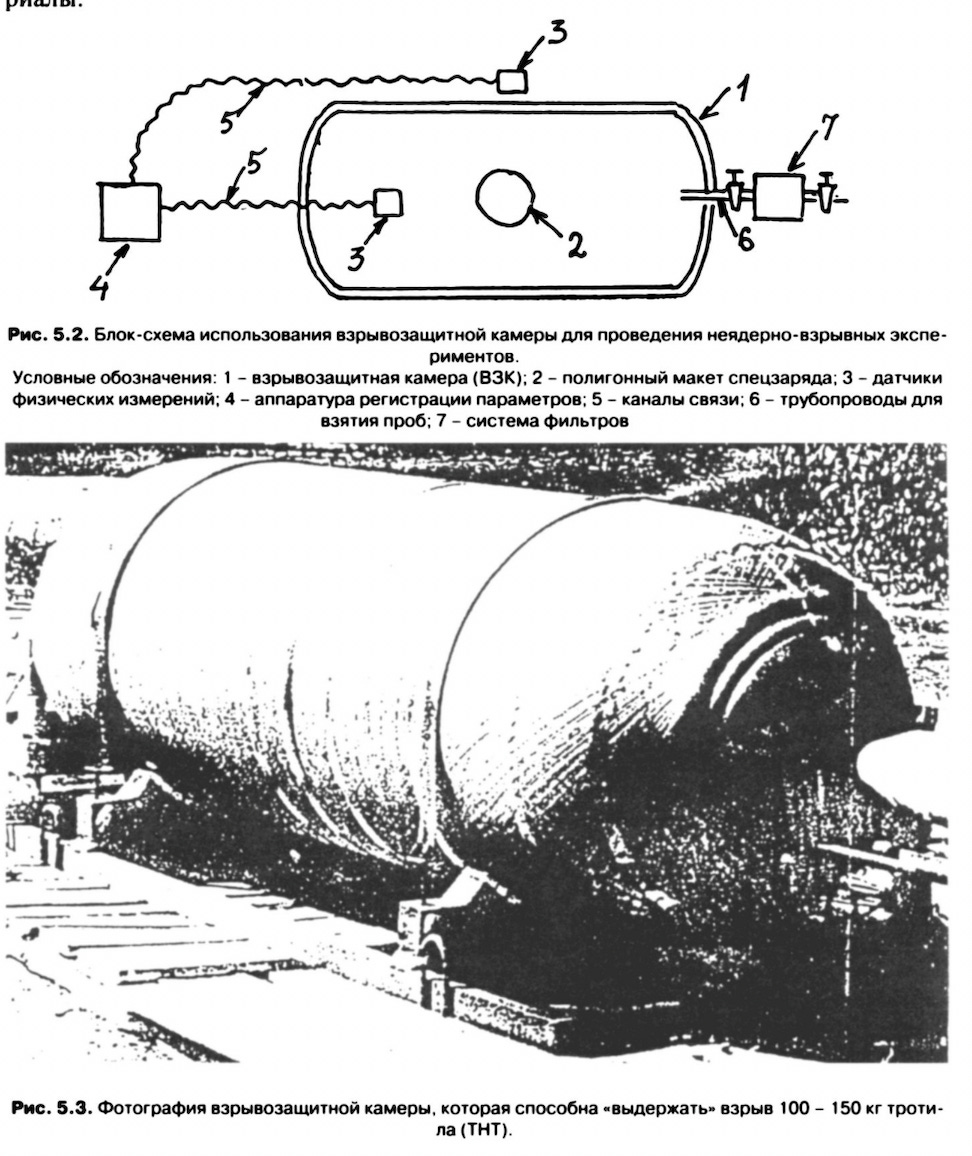
By the mid-1960s, VNIIEF and its sister institute, VNIITF (Chelyabinsk-70), had refined the technique into a formal testing regime. Official publications from the period describe “90 NCR experiments between 1958 and 1989”, conducted at Novaya Zemlya and Semipalatinsk. Each involved instrumented mock-ups containing small quantities of fissile material, diagnostic detectors, and—in many cases—explosion-proof containment chambers capable of withstanding blasts equivalent to 100–150 kilograms of TNT. Archival accounts from Rosatom’s Heritage of Russia series describe these experiments with unusual frankness. When such test devices were detonated, “radioactive substances were dispersed, which may contain a certain amount of fissile materials.”
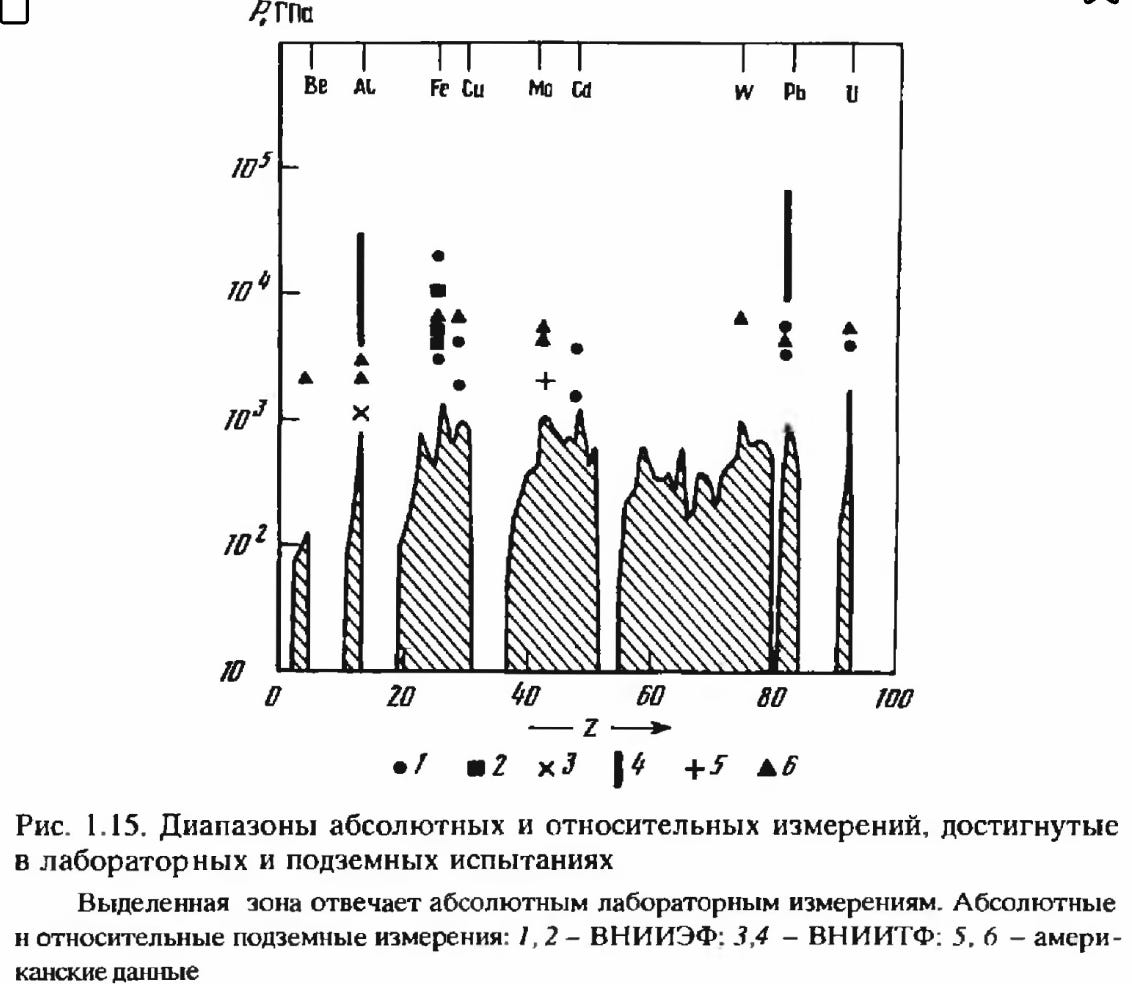
Measurement ranges for uranium and plutonium compressibility. The shaded zone shows absolute laboratory results; data from VNIIEF and VNIITF overlap with U.S. hydronuclear measurements. This figure is effectively a cross-validation of the NCR/hydronuclear method at pressures near 100 Mbar.
In Soviet terminology, this definition established a quantitative threshold: a hydronuclear test was one in which the fission energy released was roughly equal to—or slightly greater than—the chemical energy driving the implosion, typically amounting to only kilograms of TNT in yield. Such experiments were treated as non-nuclear for classification purposes, since they produced no militarily significant energy release, but in physical terms they still involved a brief, supercritical chain reaction and therefore represented the lowest rung of actual nuclear testing.
“Explosive experiments with nuclear charges in which the amount of released nuclear energy is comparable to the energy of the chemical explosives are classified as hydronuclear tests (гидроядерные испытания). These are also not considered nuclear tests, unless this result occurs in a specially planned nuclear test.”
The Soviet aim was not weapon design per se, but validation. Hydronuclear experiments provided the data to model implosion symmetry, neutron behavior, and the compressibility of fissile metals—critical to predicting the performance and safety margins of stockpiled weapons.
After the Collapse: Testing in the CTBT Era
The collapse of the Soviet Union coincided with the international movement to halt all nuclear testing. The Comprehensive Nuclear-Test-Ban Treaty (CTBT)—opened for signature in 1996—prohibited “any nuclear weapon test explosion or any other nuclear explosion”, effectively extending the earlier Partial Test Ban Treaty’s atmospheric ban to all environments. Russia signed the CTBT in 1996 and ratified it in 2000, though it subsequently withdrew its ratification in 2023.
Post-Soviet budgets were thin, and the Arctic facilities at Novaya Zemlya fell into disrepair. Yet, as Nuclear Testing: Book 1 (a Rosatom publication) makes clear, the site never went dark. Its laboratories continued subcritical testing in underground tunnels, using explosion-proof containment vessels and improved diagnostics. The goal was twofold: to ensure the safety of aging warheads and to preserve the capability to resume full testing “in case of need.”
By 1995, Russia had already resumed controlled experiments at Novaya Zemlya—four subcritical detonations that, as internal reports later noted, became the technical basis for Moscow’s decision to sign the CTBT. These experiments simulated the implosion phase of a weapon using small amounts of plutonium but stopped short of triggering a chain reaction. In other words, the fissile core was compressed to high density but never reached a supercritical state, where neutron multiplication would sustain a runaway fission reaction and produce a measurable yield. The results convinced officials at MinAtom and the 12th Main Directorate that Russia could continue evaluating its nuclear arsenal without crossing the CTBT’s “zero-yield” threshold. Crucially, Russian officials, in the past, confirmed their adherence to the zero-yield standard.
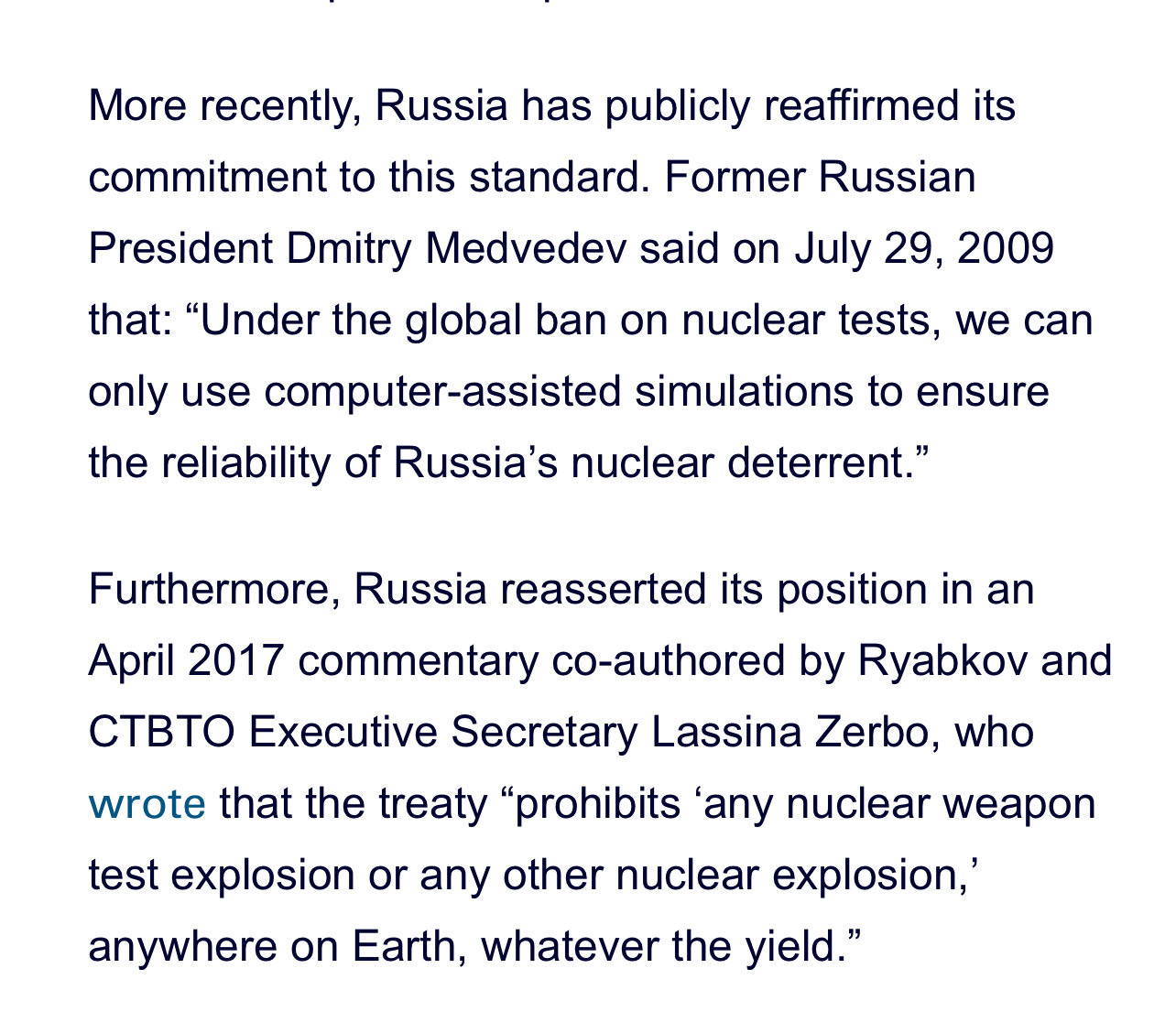
From an ACA report on the question
After the CTBT’s signing, Novaya Zemlya was quietly repositioned as a standing test complex in reserve. Subcritical and hydrodynamic experiments became the backbone of Russia’s stockpile stewardship strategy. These experiments, performed under joint supervision of Rosatom and the Ministry of Defense, used highly aged plutonium samples to study degradation effects and to validate computational models. Officials described them as both a scientific necessity and a political safeguard: a way to keep the technical chain of knowledge intact and the facilities “warm” for possible reactivation.
Viktor Mikhailov and the Question of Testing
Although Russia officially halted hydronuclear experiments after signing the CTBT, its officials periodically made statements suggesting that research of this kind had not entirely ceased. U.S. State Department compliance reports have raised concerns that Russia may have continued to conduct low-yield hydronuclear experiments at Novaya Zemlya—activities that could have crossed the boundary of the CTBT’s “zero-yield” standard. Several public statements from Viktor N. Mikhailov, the first Minister for Atomic Energy of the Russian Federation (1992–1998) and one of the central figures in maintaining Russia’s nuclear testing infrastructure through the country’s post-Soviet collapse, have alluded to engaging in such activities.
A nuclear physicist by training, Mikhailov specialized in non-explosive chain reactions, the theoretical and experimental basis for Soviet hydronuclear tests. During the 1990s, amid the economic chaos and industrial contraction that followed the fall of the USSR, he played a decisive role in preserving the scientific and technical core of the Russian weapons complex. Under his direction, the Ministry for Atomic Energy (MinAtom) kept the Novaya Zemlya test site intact, modernized its diagnostic facilities, and maintained readiness for both subcritical and hydrodynamic experiments. In a period when Russia’s nuclear industry was losing funding and personnel, Mikhailov ensured that the infrastructure and expertise for testing survived in a dormant but recoverable form.
In a 2001 article, he explained:
“Advanced nuclear powers, through hydronuclear experiments, can solve the tasks of increasing the reliability of the nuclear arsenal and effectively ensure its operation, reducing the risk of possible incidents.”
He added a crucial caveat:
“However, to create new models of nuclear weapons on the basis of these experiments—no state can. The absence of full-scale testing does not allow one to be certain of the correctness of the chosen physical scheme or weapon design.”
The message was that hydronuclear experiments could sustain, but not advance, Russia’s arsenal. Yet, by institutionalizing these experiments, Mikhailov ensured that Russia never fully stopped testing—it simply redefined what “testing” meant.
In one of his final retrospectives, published in Byulleten’ Atomnoy Energii in 2008 and titled “Each Nuclear Test — A Particle of One’s Life Given to Science,” Mikhailov described how his diploma research on non-explosive chain reactions had acquired new significance in the post-test-ban era. He wrote that, under the prohibition of full-scale testing, this approach became “the main instrument for ensuring the reliability of nuclear munitions.” He emphasized that hydrodynamic or hydronuclear experiments—using small quantities of fissile material under intense explosive compression—remained essential for studying how weapon components behaved under real detonation conditions.
Russia retained this ability throughout the post-Soviet period, preserving both the infrastructure and the legal framework to resume testing if required. The 2000 law “On the Ratification of the CTBT” requires the government to maintain “the basic potential for possible resumption of nuclear tests in case the Russian Federation withdraws from the Treaty.” In practice, this means keeping Novaya Zemlya operational for non-nuclear, subcritical, and hydrodynamic experiments, training new generations of test engineers, and maintaining the capacity to restart full-yield testing within months.
Over the past several years, senior Russian officials—including President Vladimir Putin, Defense Minister Sergei Shoigu, and Rosatom Director Alexei Likhachev—have repeatedly stated that Russia is prepared to resume nuclear testing “if the United States does so first.” These public remarks, alongside visible infrastructure activity at Novaya Zemlya, reaffirm that the capability remains active—and that Russia’s legal and political framework treats testing not as a relic of the past, but as a dormant option.
Does this matter?
Hydronuclear experiments occupy a uniquely ambiguous space in the history of nuclear testing. Their yields are so small and contained that they are exceedingly difficult to detect or distinguish from legally permissible subcritical tests. Even advanced seismic and radionuclide monitoring systems, like those operated by the CTBT Organization’s International Monitoring System, would struggle to identify such events unless an experiment unintentionally “ran away” or vented radioactive gases. This ambiguity has fueled the long-running compliance dispute between Washington and Moscow.
While these experiments provide high-fidelity data on fissile material behavior under compression, their utility for verifying or improving existing warhead designs remains limited. Viktor Mikhailov acknowledged as much—arguing that hydronuclear tests could sustain confidence in the arsenal, but not substitute for full-scale nuclear trials. Whether Russia is actually conducting supercritical hydronuclear tests remains an open question. However, if Moscow were conducting hydronuclear experiments, this would clearly violate the CTBT’s zero-yield standard.
Resuming hydronuclear or any form of nuclear testing would be deeply counterproductive for the United States. Doing so would undermine Washington’s long-standing commitment to the zero-yield standard and almost certainly trigger even more escalatory reciprocal actions by Russia or China. Moreover, U.S. stockpile stewardship programs already provide a high level of confidence in warhead reliability through advanced simulation, subcritical experiments, and materials testing. A resumption of testing would therefore yield limited technical benefit while legitimizing others’ violations.
very interesting article. thank you for doing all that research. a question came to mind. how do we know if all those nuclear weapons, which are getting very old now, would work if they were
fired without doing any testing? or is that a different question?
Great research