

On February 28, 2026, the United States and Israel launched a coordinated military campaign against Iran codenamed Operation Epic Fury (US) and Operation Roaring Lion (Israel). Just two days earlier, Oman’s Foreign Minister had announced a diplomatic breakthrough. In retrospect, the nuclear talks were clearly a sideshow for what would come next.
The opening messaging from the U.S. and Israel made the scale of the campaign clear. In an eight-minute video posted to Truth Social, President Trump outlined the campaign’s objectives in blunt terms: destroy Iran’s missiles, dismantle its missile industry, and eliminate its naval capabilities. Shortly afterward, Israeli Prime Minister Benjamin Netanyahu released a message addressed directly to the Iranian public in Farsi, urging them to “come to the streets, come out in your millions, to finish the job.” Taken together, the statements suggested that the campaign was intended not only to degrade Iran’s military capabilities but also to place pressure on the political system itself.
I have written elsewhere about the shifting U.S. justifications for confrontation with Iran in the months leading up to the war. Rather than revisit those debates, this post tries to answer a simpler question, albeit with incomplete information, what does the targeting itself suggest about the objectives of the campaign?
This is not intended to be a comprehensive catalogue of every strike or claim. Much of the information circulating publicly is fragmentary, and open-source reporting often mixes confirmed strikes with unverified reports. Instead, the goal here is to step back from the noise and look at the broader targeting pattern in order to understand what the operational objectives of the campaign might be.
As with any early assessment of an ongoing war, there are likely gaps and errors in what follows. Some targets remain unconfirmed, some sites may have been misidentified, and additional strikes will almost certainly come to light as satellite imagery and independent reporting catch up with events on the ground. What follows should therefore be read as an attempt to interpret the campaign’s emerging logic rather than a definitive accounting of the war.
So far, the strikes appear to fall into overlapping lines of effort: suppressing Iran’s air defenses, degrading its ballistic missile force, eliminating political and military leadership, and weakening its ability to project power outward. CSIS analysis suggests that the U.S. and Israel appear to have divided labor, with Israel handling leadership decapitation and the US conducting large-scale capability degradation.
Leadership and Governance Targeting
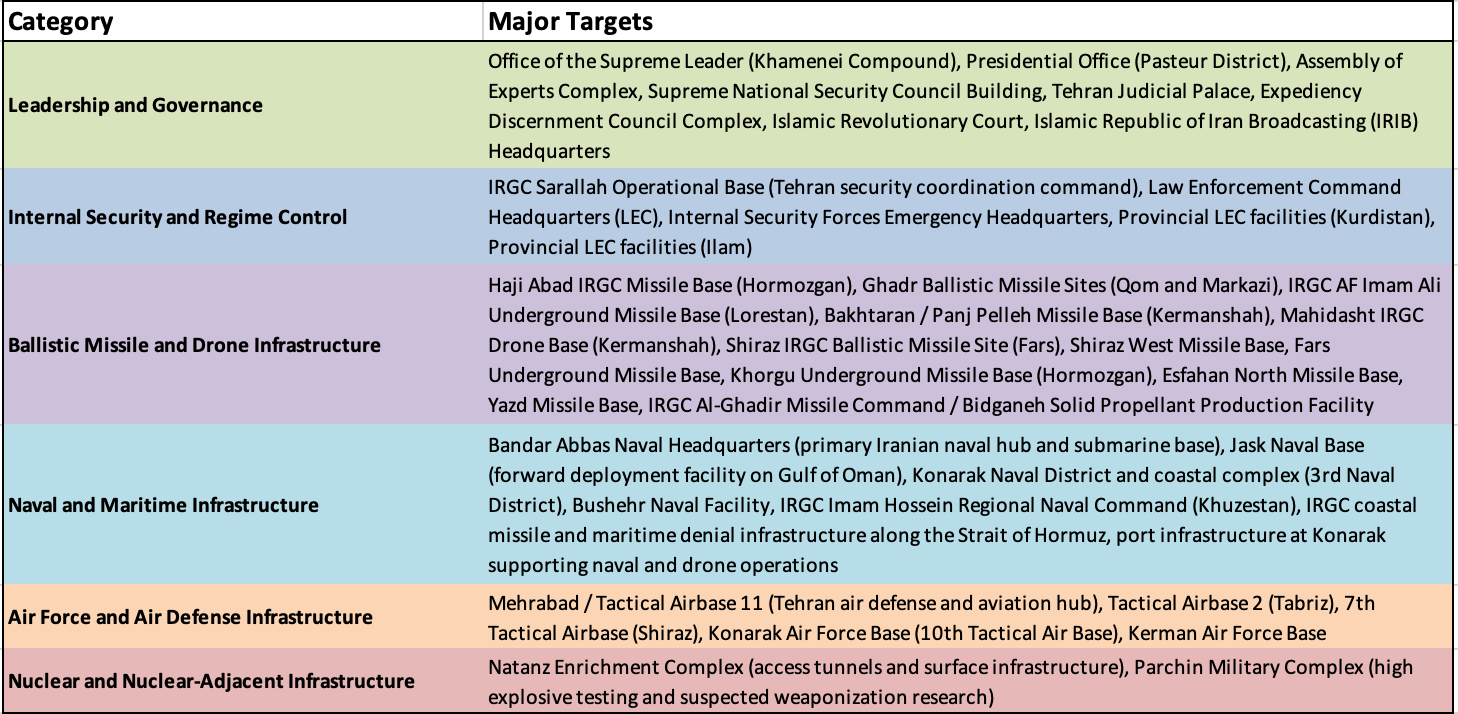
The opening phase of the campaign combined leadership targeting with early suppression of air defenses around Tehran. On the first day of strikes, February 28, one of the earliest confirmed targets was the Office of the Supreme Leader in northern Tehran. Beginning the operation with a strike against the compound associated with Ali Khamenei immediately set the tone for the campaign. Rather than focusing exclusively on military infrastructure in the opening hours, the targeting extended directly into the political center of the Iranian state.
Within the same early period, additional strikes were reported near the Tehran Judicial Palace and at Mehrabad Airport. Mehrabad sits within Tehran’s broader air defense network and hosts military aviation infrastructure tied to Tactical Airbase 11, including radar and missile systems deployed to defend the capital. Striking the airport, therefore, served two purposes at once. It degraded elements of Tehran’s air defense coverage while also signaling that the capital’s core political and military sites were exposed.
Subsequently, the Presidential Office, the Assembly of Experts meeting site, and the Supreme National Security Council building were all struck within a short window. These institutions are clustered in Tehran’s Pasteur district and together form the governing architecture of the Islamic Republic. Other sites linked to the judiciary and the Expediency Discernment Council complex also appeared to have been targeted. Like the June 2025 war, the headquarters of Islamic Republic of Iran Broadcasting was struck and then struck again.
Running alongside the government apparatus targets is a distinct thread of strikes against Iran’s internal coercive apparatus: the institutions the regime relies on to manage domestic unrest. The IRGC Sarallah Operational Base, the primary IRGC security coordination hub in Tehran, was struck. So were the Law Enforcement Command headquarters and the Internal Security Forces Emergency HQ. These are the organizations that suppressed the mass protests of January 2026. The targeting extended to the provinces, with Law Enforcement Command facilities confirmed struck in Kurdistan and Ilam, suggesting an attempt to disrupt internal security coordination across the country at once rather than simply decapitating it in the capital. Their presence in the target set is consistent with the campaign’s declared regime-change objective: degrading the instruments of domestic repression in parallel with the instruments of external military power.
Ballistic Missiles
Iran’s ballistic missile force sits at the center of its military strategy, and that reality is clearly reflected in the targeting pattern so far. Over the past two decades, Tehran has built a large and increasingly diverse missile arsenal that functions as its primary deterrent against Israel and as one of its most reliable tools for projecting power across the region. The Islamic Revolutionary Guard Corps Aerospace Force (IRGC-AF) oversees this inventory, which includes medium-range systems capable of reaching Israel, alongside shorter-range missiles for targeting the Persian Gulf. Taken together, this missile force represents Iran’s most credible retaliatory capability and one of the few ways it can impose meaningful costs on adversaries beyond its borders.
Just as important as the missiles themselves is the infrastructure that supports them. Iran’s missile force is deliberately dispersed across a network of underground complexes, hardened storage sites, and mobile launcher garrisons spread across the country. Many of these facilities are embedded in mountainous terrain, particularly along the Zagros range in western Iran, while others are located across the central plateau and the southern provinces along the Persian Gulf. It is designed to ensure survivability and to allow Iran to continue generating launches even after absorbing strikes
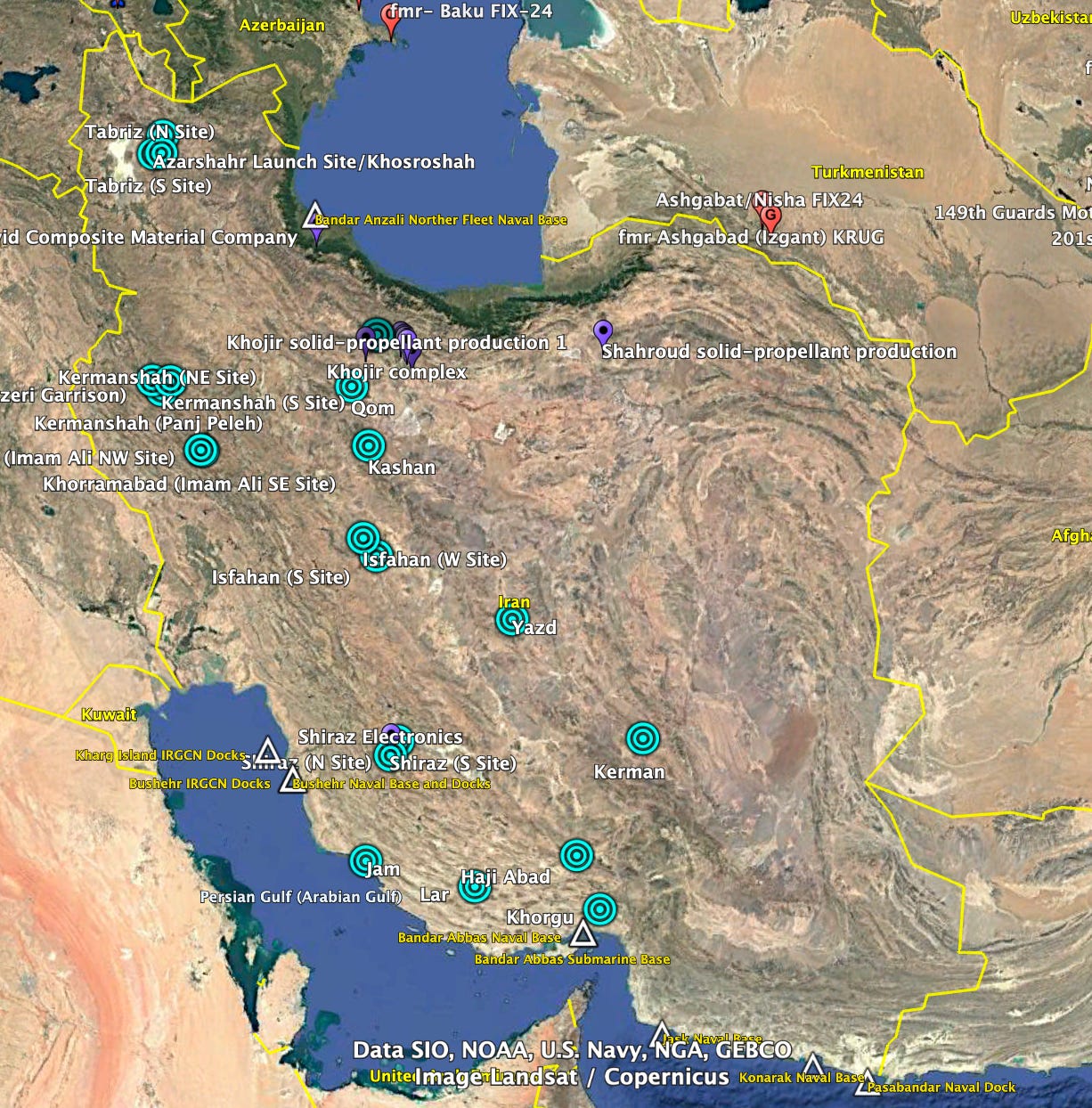
.The strike data from the first several days of the campaign suggests that missile infrastructure has been a central priority, which is not at all surprising. Missile-related sites account for a significant share of the confirmed strikes, more than any other category in the known targets. The geographic spread is also striking. Facilities tied to missile operations appear in Lorestan, Kermanshah, Hormozgan, Fars, Esfahan, Yazd, Qom, Markazi, and Tehran provinces.
The first day of strikes already pointed in this direction. Early engagements appear to have focused on facilities that were more accessible while air defenses were still being suppressed. One of the earliest reported strikes targeted the Haji Abad IRGC Missile Base in Hormozgan, which is associated with an underground missile complex used by the IRGC Aerospace Force. Later that same day, sites associated with the Ghadr-series ballistic missiles were reportedly struck in both Qom and Markazi provinces. The Ghadr H-1 ballistic missile site appeared at two separate locations in the strike reporting, consistent with the dispersed basing posture of Iran’s medium-range missile forces.
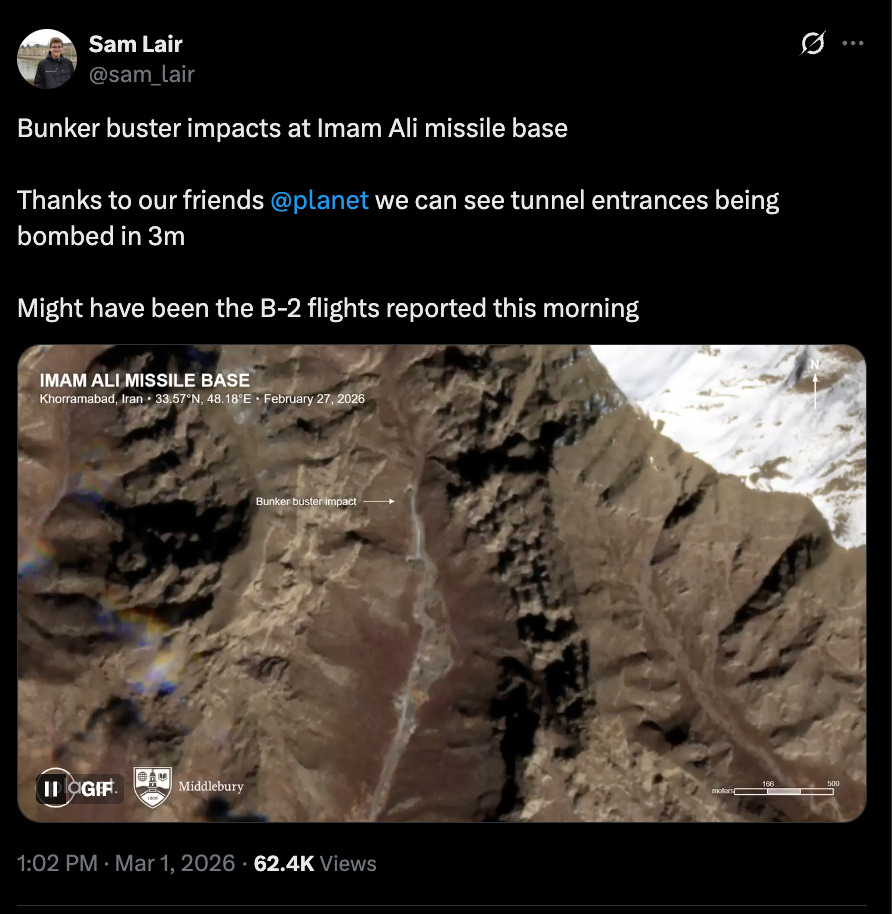
As the campaign moved into the second and third days, and as Iranian air defenses were degraded, strikes began to reach deeper and harder targets. Several confirmed strikes appeared across the western missile belt along the Zagros mountains. The IRGC AF Imam Ali Underground Missile Base in Lorestan was confirmed struck during this phase, one of Iran’s principal underground missile storage complexes believed to house medium-range systems. In neighboring Kermanshah province, the Bakhtaran (Panj Pelleh) Missile Base also appeared in the strike reporting after earlier explosions were reported in the same area. Another confirmed strike hit the Mahidasht IRGC Drone Base in the same province, indicating that infrastructure tied to Iran’s drone strike capabilities is also part of the broader target set.
Further east towards central Iran, missile facilities around Isfahan and Yazd were also targeted during the following days of the campaign. The Esfahan North Missile Base appeared in the strike reporting and was later struck again, as reflected in a second entry tied to the same location here. The Yazd Missile Base also appears in the strike data. Its inclusion is notable because Yazd lies outside the main western missile belt, suggesting the strike list extends beyond Iran’s primary basing clusters to include reserve dispersal locations.
In southern Iran, missile infrastructure in both Fars and Hormozgan provinces was also targeted. The Shiraz IRGC Ballistic Missile Site and Fars Underground Missile Base appeared in the reporting during the second phase of the campaign, followed shortly by a strike on the Shiraz West Missile Base. Two facilities within the same regional complex being struck within a short period suggests a coordinated effort to degrade the broader Shiraz basing network. Further south, the Khorgu Underground Missile Base in Hormozgan was also confirmed struck, extending the missile campaign into Iran’s southern basing zone.
One of the most strategically significant strikes during these days appears to have targeted production infrastructure rather than storage or launch facilities. The IRGC Al Ghadir Missile Command site linked to the Bidganeh solid-propellant production facility was confirmed struck during this phase. Bidganeh is widely assessed as one of Iran’s primary sites for producing the solid rocket motors used in systems like the Fateh and Zolfaghar missile families. Damage to a facility like this has implications that extend beyond the missiles currently deployed because it directly affects Iran’s ability to regenerate those capabilities in the future.
Another feature of the missile campaign is the apparent re-engagement of certain sites across multiple days. The Haji Abad missile complex appears again in later strike reporting after the initial engagement on the first day. Similarly, the Esfahan North missile base appears more than once in the dataset. This pattern is consistent with campaigns against hardened underground infrastructure.
Naval and Air Force
After the strikes on Iran’s missile infrastructure, the next layer of the campaign appears to focus on the systems that allow Iran to project power outward and defend its airspace. Naval installations, coastal military infrastructure, and tactical air bases appear repeatedly in the strike data.
Iran’s naval posture is built around an asymmetric strategy in the Persian Gulf and Gulf of Oman. The IRGC Navy and the conventional Iranian Navy divide responsibilities between them. The IRGC Navy focuses on fast attack craft, coastal missile batteries, drones, and other systems designed to threaten shipping in the shallow waters of the Gulf. The conventional navy operates larger surface vessels and submarines from bases such as Bandar Abbas and, more recently, from the facility at Jask on the Gulf of Oman. These naval forces are also integrated with Iran’s broader missile architecture. Anti-ship missiles, coastal radars, and drone launch infrastructure are often colocated with naval bases, and in some cases share command and logistical infrastructure with the IRGC-AF. As a result, targeting naval facilities can simultaneously degrade maritime denial capabilities and parts of Iran’s missile ecosystem.
Several naval installations and coastal facilities appear in the reporting across the first days of the campaign. One of the most heavily struck locations is the Konarak complex on Iran’s southeastern coast in Sistan and Baluchistan province. The site hosts the 3rd Naval District, Tactical Airbase 10, and nearby IRGC drone storage and launch infrastructure. The 10th Artesh Air Force Fighter Base at Konarak was struck early in the campaign, and subsequent reporting indicates that the naval district itself was hit again later in the operation through confirmed strikes on the same complex here and here. Separate strikes also targeted the drone facilities connected to the base here. Satellite imagery released after the attacks shows significant damage to the site, including an Iranian naval vessel burning at the port facility (imagery here).
Bandar Abbas, Iran’s primary naval hub and home to its submarine fleet and the anti-ship missile batteries covering the Strait of Hormuz, appeared in early strike reporting and was struck again in subsequent days, with additional confirmed hits on the broader headquarters complex. The naval facility at Jask, developed in recent years specifically to allow Iranian naval vessels to deploy outside the Strait of Hormuz and into the wider Arabian Sea, also appears in the strike reporting. Along the northern Gulf, the IRGC's 3rd Imam Hossein regional command in Khuzestan was confirmed struck, along with a Bushehr province naval facility. These are the coastal assets Iran would use to widen the conflict at sea, and their degradation reduces Iran’s ability to threaten regional shipping and energy infrastructure. Trump announced on March 1 that nine Iranian warships had been sunk and Iran's naval headquarters destroyed.
Tactical air bases received parallel attention throughout the campaign. The Iranian air force flies an aging mix of F-14s, F-4s, MiG-29s, and domestically produced Kowsar fighters that could not contest air superiority against a peer adversary. The operational concern is not Iranian offensive airpower per se but the infrastructure these bases represent: radar networks, maintenance facilities, air defense coordination nodes, and in some cases missile storage. To this end, the campaign struck Tactical Airbase 2 near Tabriz in the northwest and again, the 7th Tactical Airbase in Shiraz, the Konarak complex on the southeastern coast, the Mehrabad/Tactical Airbase 11 complex near Tehran, and the Kerman Air Force Base further south.
Nuclear Targets
Compared with the breadth of targeting against missile infrastructure, naval facilities, air bases, and leadership institutions, nuclear-related targets appear only sporadically in the strike data so far. The campaign has clearly touched parts of Iran’s nuclear and defense-industrial ecosystem, but these strikes make up a relatively small portion of the overall target set. Most of the confirmed and reported engagements have instead focused on missile forces, air defenses, military command nodes, and internal security infrastructure. Nuclear facilities appear in the dataset, but they are not the dominant feature of the campaign.
The most clearly documented strike on a nuclear facility is the attack on the Natanz Enrichment Complex. Prior to June 2025, Natanz was the core of Iran’s uranium enrichment program and hosted large underground halls containing centrifuge cascades used to produce enriched uranium. After the Israeli-U.S. strikes in June 2025 damaged portions of the complex, Iran began efforts to restore operations and shift activity toward hardened and underground infrastructure. Western intelligence assessments and IAEA reporting indicated that Tehran was attempting to repair damaged surface infrastructure while also relying more heavily on protected facilities and dispersal of equipment across the enrichment network. In the current campaign, the IAEA confirmed on March 3 that access tunnels and surface entrance infrastructure at Natanz were damaged.
Parchin is the nuclear-adjacent site appearing most frequently in the available data, referenced here, here, and here. The complex southeast of Tehran has long been associated with high-explosive testing and suspected weapons-development experiments that international inspectors have never been able to fully investigate. Its repeated appearance suggests sustained interest from the planner, though open-source reporting has not yet established the extent of the damage.
Two other locations that frequently surfaced in discussions about Iran’s nuclear activities prior to this war do not appear to have been targeted yet (or at least no confirmation). They are Taleghan-2 and the so-called Pickaxe Mountain site.
Taleghan-2 sits inside the Parchin military complex and has been associated with Iran’s earlier nuclear weapons development work under the Amad Plan. The facility reportedly housed a high-explosive test chamber used for experiments relevant to nuclear weapon implosion systems, and it was previously damaged in an Israeli strike in 2024. Satellite imagery since mid-2025 shows Iran rebuilding and then burying the new structure under soil and a concrete shell, likely to protect it from future air attacks. Meanwhile, the Pickaxe Mountain site, located near the Natanz complex, has also drawn attention from analysts who believe Iran may be constructing a deeply buried facility there that could potentially host covert enrichment activity. Satellite imagery following the June 2025 strikes showed continued tunneling and construction activity around the site, raising concerns that Iran may be dispersing parts of its nuclear program into more hardened underground infrastructure. I assume these sites will be targeted in the coming days, let’s see.
What stands out in the overall picture is the disproportion. Missile infrastructure, air defenses, naval forces, air bases, and leadership institutions account for the overwhelming majority of confirmed strikes.
What’s Next
With the caveat that much of the targeting picture is still incomplete, one pattern already stands out: leadership and governance appear to be playing an unusually prominent role in this campaign. That does not mean the operation is primarily about decapitation. Missile infrastructure, air defenses, naval facilities, and air bases dominate the strike data. But compared with past Israeli operations against Iran, the frequency with which political and internal security institutions appear in the target set is striking.
It is also worth remembering how incomplete early wartime information can be. During the June 2025 conflict, it only became clear after the war ended that Israel had targeted a meeting of Iran’s Supreme National Security Council. At the time, it barely appeared in open-source reporting. Something similar could easily be happening here. Some of the most consequential strikes may not become fully visible until much later, once satellite imagery, intelligence leaks, and retrospective reporting fill in the gaps.
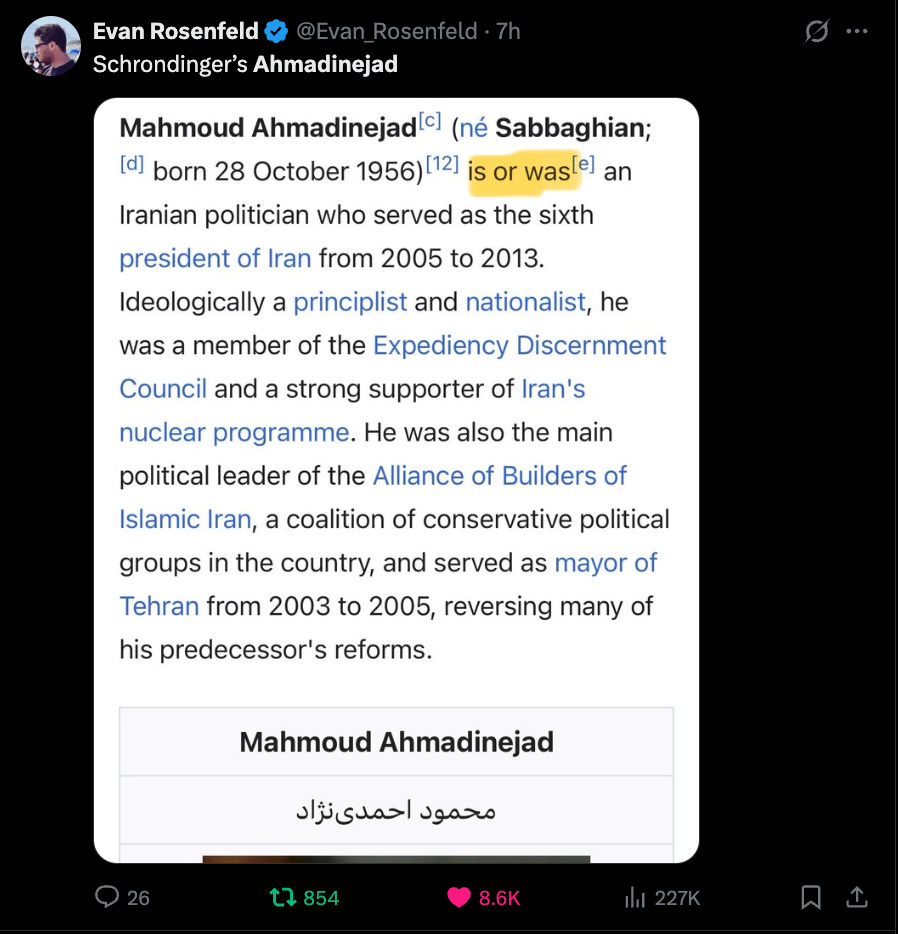
At the moment, there are more questions than answers. I have found myself messaging other Iran specialists repeatedly over the past few days, asking some version of the same question: “Is X still alive?” The uncertainty itself says something about the nature of the campaign.
It reminds me of Opn Desert Fox when the Clinton administration claimed to be hitting Iraqi WMD sites but in reality it was all military, security forces, and leadership targets.
Thanks. Where do you find this data?