

With the expiration of New START, Russia regains formal freedom to expand its strategic nuclear forces beyond treaty limits. But Moscow’s likely response should not be understood as a rush toward numerical arms racing. Russian behavior will instead reflect a familiar pattern: preserve strategic deterrence at relatively stable levels while shifting competition into domains that are cheaper, less regulated, and more politically useful.
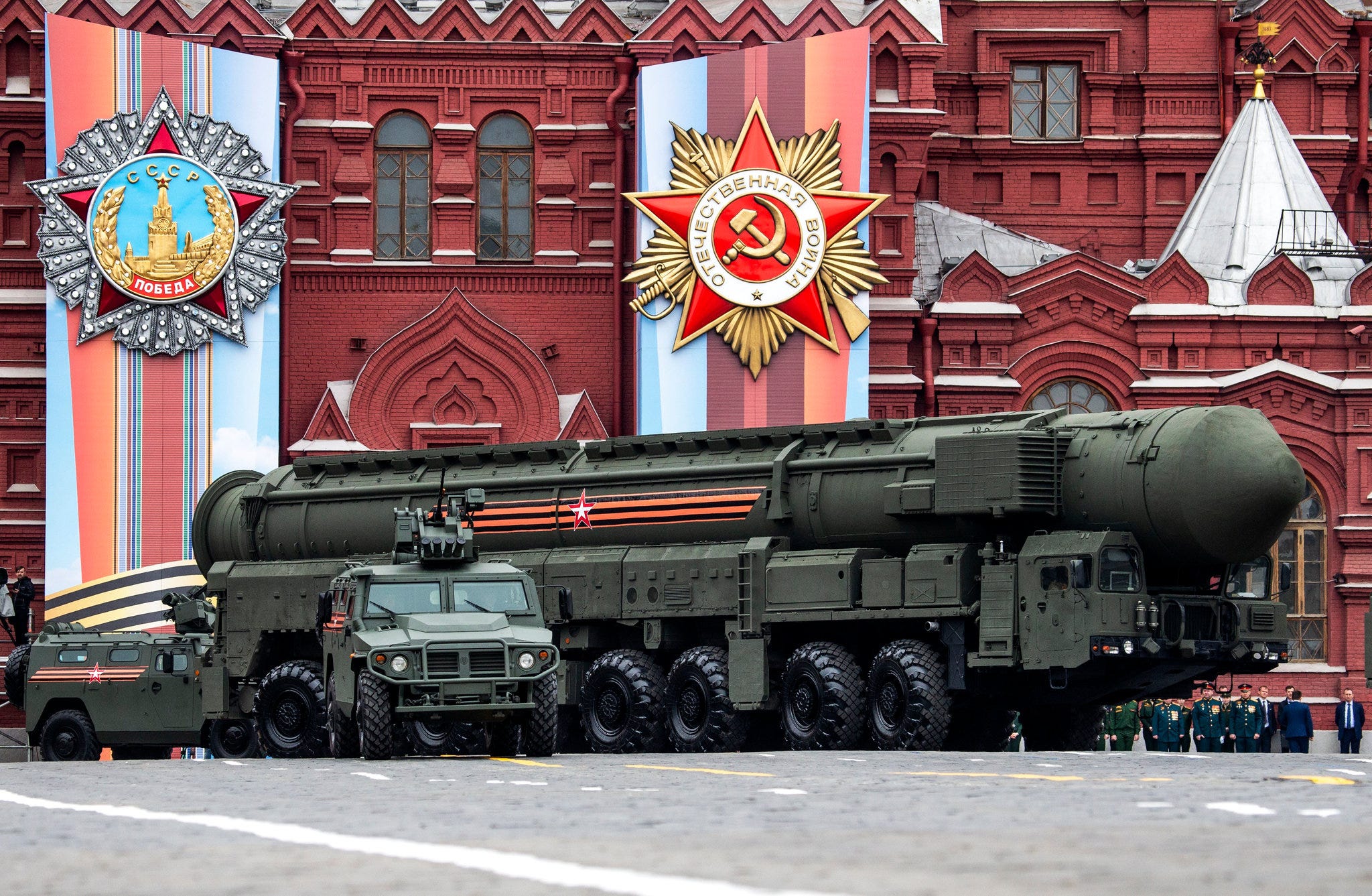
In the near term, Russia is likely to keep its deployed strategic forces close to former New START ceilings. Doing so serves several purposes. It sustains Moscow’s long-standing narrative that it is not seeking an arms race, avoids triggering immediate U.S. uploading or force expansion, and remains fiscally sensible under sanctions and wartime strain. Russian planners have long emphasized survivability over aggregate numbers, and New START’s ceilings were never viewed in Moscow as operationally constraining. Maintaining rough continuity in deployed strategic forces allows Russia to project restraint while preserving flexibility.
At the same time, Russia will preserve and quietly expand its upload hedge. This is where New START’s expiration matters most operationally. MIRVed systems such as RS-24 Yars and, eventually, RS-28 Sarmat were deliberately designed with latent warhead capacity. Under treaty constraints, Russia typically deployed fewer reentry vehicles per missile than technically possible. Post-2026, Moscow can incrementally increase loading without fielding new launchers. Importantly, the binding constraint here is not warhead availability. Russia maintains a continuously active warhead production and refurbishment complex. The bottlenecks lie in non-nuclear components: reentry vehicles, penetration aids, post-boost vehicles, guidance electronics, and quality-controlled solid-fuel production. These constraints make a rapid breakout implausible, but they do support gradual, selective uploading over time as a hedge against U.S. or Chinese developments.
Where Russia is most likely to expand is outside the strategic category altogether. Non-strategic nuclear weapons and intermediate-range delivery systems are cheaper to field, draw on existing production lines, and are directly relevant to Russia’s core contingencies in Europe. These forces also sit outside the categories Washington has traditionally prioritized in arms control, allowing Moscow to expand capabilities without formally violating any remaining norms.
Russia will also continue to prioritize survivability and counters to U.S. damage-limitation strategies rather than numerical parity. This includes investments in mobility, hardening, redundancy in command and control, and counterspace capabilities intended to offset U.S. ISR and missile defense. Novel systems such as Avangard, Poseidon, and Burevestnik fit into this logic as asymmetric hedges rather than replacements for the triad. Their operational value is uneven and, in some cases, uncertain. But from Moscow’s perspective, they impose planning costs on the United States and provide insurance against future technological breakthroughs that could erode second-strike survivability. These systems also function as bargaining chips in any future arms control discussions.
Doctrinally, Russia’s post-New START behavior will be reinforced by recent revisions to its nuclear policy, which broaden conditions under which nuclear use is contemplated. These changes reflect perceived vulnerability to conventional precision strike, aerospace attack, and threats to command continuity. They do not signal eagerness to use nuclear weapons, but they do legitimize greater reliance on non-strategic nuclear options and theater-level signaling. Combined with intermediate-range deployments, this doctrinal shift lowers thresholds in ways that are difficult to manage in a crisis.
Diplomatically, Moscow is unlikely to pursue a New START-style successor focused on aggregate warhead limits. Instead, Russia will push for narrower arrangements aimed at constraining specific U.S. capabilities it views as destabilizing, including missile defense, long-range precision strike, and theater-range deployments in Europe. Any arms control proposal will be framed instrumentally, not as a normative commitment to restraint, but as a way to bind U.S. advantages while preserving Russian freedom of action elsewhere.
Finally, China will remain the silent driver of Russian hedging. Publicly, Moscow will continue to downplay Beijing’s role. Privately, China’s expanding arsenal reinforces Russia’s reluctance to accept any framework that locks it into parity with the United States while leaving China unconstrained.
The most likely outcome after New START is not a dramatic arms race but a steady pattern of selective adaptation. Russia will hedge, probe, and shift competition into less transparent domains, increasing ambiguity and complicating control over escalation, even in the absence of large numerical changes.
"Russia regains formal freedom to expand" - yes, but why only Russia? The "formal freedom" seems more important to the US. Russia would be perfectly happy not to have this freedom, especially, as you correctly note, its capability to take advantage of it is limited.
And I would disagree about the role of China - Russia would be happy "to accept any framework that locks it into parity with the United States." Parity with the US is the key concept here.